

It’s gotta be the shoes.
Photographer: Alex Grimm/Getty Images
Photographer: Alex Grimm/Getty Images
In just four years, Adidas AG, the German sporting goods manufacturer, has realized that its highly automated “Speedfactories” in Germany and the U.S. weren’t a great idea and it’s best to keep making athletic shoes in Asia. That doesn’t mean, however, that the whole idea of “reshoring” production to be closer to customers is wrong.
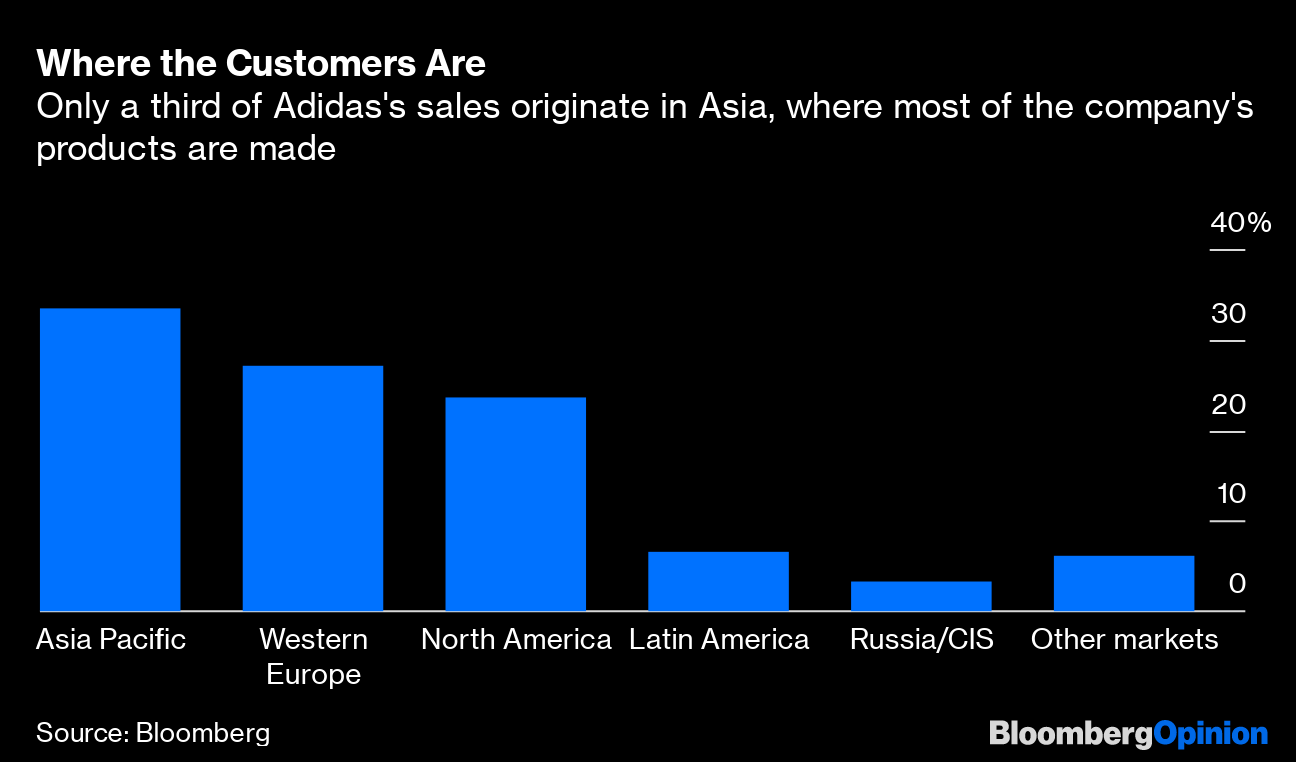
The first Speedfactory, a joint project with plastics specialist Oechsler AG, was set up in the small Bavarian city of Ansbach in 2015. It was meant to use 3D printing and robotics, and no manual labor, to shorten the delivery time to European consumers. Last year, a second one opened in Atlanta. The company’s rationale was clear: It makes some 90% of its shoes in Asia, but less than a third of its sales originate there.
Where the Customers Are
Only a third of Adidas’s sales originate in Asia, where most of the company’s products are made
Source: Bloomberg
Now both factories are going to close by April, 2020, and the equipment is going to two Adidas suppliers in China and Vietnam — “where the know-how and the suppliers are located,” according to a company representative. The implication is that the innovative production lines weren’t worth making exceptions from the company’s tried-and-true logistical schemes. And indeed, Adidas makes 400 million pairs of shoes a year, while the Ansbach factory, capable of turning out 500,000 pairs of shoes a year, didn’t even operate at full capacity.
Adidas’s investment won’t go to waste, and of the factories’ combined 160 jobs, any that are lost probably will be at Oechsler — which also has gained valuable experience outside the auto-component industry, to which most of its production is geared. The project’s closure, however, is sad news for champions of reshoring, who hope the changing consumer mindset — the culture of instant gratification combined with a craving for individuality — has a chance to bring manufacturing back to Europe and North America.
According to the Reshoring Initiative, which tracks and tries to encourage the return of factories to the U.S., 560 companies from the apparel and textiles industry have moved production back to the U.S. between 2010 and 2018, second only to the transportation-equipment sector. There’s evidence of modest production growth in the apparel industry in the U.S. (though not in Germany).
In some cases, keeping at least some production processes close to the end consumer has been a defining success factor. One example is Fanatics Inc., a uniform supplier to both professional sports teams and fans, which is able quickly to turn out a jersey with any name, number and team colors. Another is Brooks Brothers, which has reshored 70% of its suit production to the U.S., mainly to cut lead times.
Adidas’s vision was about fast customization, too. Like its competitors Nike Inc., Brooks Sports Inc. and Salomon SAS, it’s been looking into the possibility of using 3D printing to make personalized shoes. It experimented with pop-up “Speedfactory Labs,” where customers could have their feet scanned to determine what type of shoe they needed. It developed a process to 3D-print customized midsoles that could be incorporated into shoes made by the Speedfactories. And it worked with retailers to get consumer input for “hyperlocal” shoe designs that would be popular in specific cities.
Full personalization, however, isn’t really feasible with current technology. Running shoes are far more complex to make than jerseys. When shoe manufacturers scan one’s feet, the best they can really do is pick the best-fitting shoe elements out of a list of those it already produces at scale. And the personalization is costly and difficult even at that level. Brooks trumpeted its “first personalized performance running shoe,” the Genesys, in May, 2018, but it’s still not available. There’s no way to gear an entire 500,000-pair-a-year factory to making bespoke shoes that would be sufficiently different for the wearer than off-the-shelf ones.
Personalization coupled with near-immediate production really could change the logistics of running-shoe manufacturing, especially if the prices approached the ones in the stores. But as things stand, most customers don’t care where and when running shoes are made. Even relatively serious runners easily can make do with last year’s model (it’s cheaper, too) and don’t rush to buy the current one while there’s still some wear in the current pair. The customers, in other words, can wait for their next shoes to arrive from Asia.
The story doesn’t have to end here, however. The experience of apparel manufacturers shows that reshoring does make sense when combined with the possibility of quick personalization. Adidas simply got ahead of itself with the Speedfactories — and ended up with some technological advances that can benefit its Asian suppliers rather than a new and exciting business model. But that model may still be within reach if the running shoe industry figures out how to scale personalization.
This column does not necessarily reflect the opinion of the editorial board or Bloomberg LP and its owners.
To contact the author of this story:
Leonid Bershidsky at lbershidsky@bloomberg.net
To contact the editor responsible for this story:
Tobin Harshaw at tharshaw@bloomberg.net


