
An object’scenter of gravity is a matter of physics. In matters of business, by contrast,there are man-made centers of gravity. These are governed by the desire to makemoney or, at least, to avoid losing money. Logistics is the study of theconstraints of time, physical space and location that arise when movingfreight/people/information from origin to destination. Interestingly, thoselogistical constraints can be matters of physics too. In particular, transportationcosts can make or break a sales transaction.
This isespecially true when the buyer and the seller are some physical distance apartwith challenging terrain and/or bodies of water in-between. The terrain and/orbodies of water will determine the nature of the infrastructure available tofor-hire carriers. The buyer-seller transaction is possible if a carrier isavailable to move the item across the available infrastructure. But thetransaction is not possible if the cost of carriage, when added to the item’ssale price, is simply too high for the buyer. This may be due to lack ofcompetition in the for-hire carrier market or to the physical constraints ofthe distances involved given the current state of technology.
Logistical constraintsneed to be managed in order to control the costs of doing business. Centers ofgravity exert the force of attraction. When market conditions change by a largeenough magnitude, business activities will be attracted to a new center. Onlyan equal and opposite force can fight this gravitational pull. What happenswhen these centers of gravity change and what does it take to maintain currentones in the face of such change?
Consider thecurrent U.S.-China trade war. The United States has chosen to fight this war primarilywith import tariffs. As a result, all U.S. supply chain managers who deal with theinbound flow of China’s tariff-targeted imports know that the landed cost of theseitems will be higher. It is not just the tariff-adjusted sale price of the itemthat is higher, but also the cost of customs compliance.
Some supplychain managers have already adjusted away from China, choosing instead tosource from nearby Taiwan, Vietnam and/or South Korea. On the export side, U.S.food and agricultural products are good cases in point. From a peak of $25billion in 2014, China-bound exports fell to about $9 billion this year. Theslide accelerated beginning in 2017 when the first serious talk of a trade warbegan. U.S. tariffs on China were met by countervailing tariffs by China on U.S.food and agricultural exports.
In a similarfashion to outbound China supply chains the inbound China supply chains of foodhave been shifting away from the United States to other countries in thishemisphere such as Canada for wheat and lobster, and Brazil for soybeans.
The effectof this shift can be seen sharply at the Port of Oakland, since about half of itsexport volume is in agricultural products. With its proximity to California’sfarm sector it is an important exit point to Asia’s food markets. The port hasseen a rise in shipments to Taiwan, Vietnam, South Korea and Japan as U.S. farmerssought to avoid China’s tariffs on their products.
A consequentialshift in the center of gravity might occur should enough manufacturers of low-costconsumer goods move beyond the Far East into countries like India andBangladesh. If these countries replace the Far East as the manufacturing centerof gravity, it is possible that some transport routes might avoid the MalaccaStrait heading to U.S. West Coast ports and use the Suez Canal and theMediterranean Sea heading to U.S. East Coast ports. If the new pool of low wageworkers is to be found in and around India this possibility must be considered.In fact, A.T. Kearney’s report this year on U.S. trade policy and reshoringnoted that the move of manufacturers from China toward India has been in motionlong before the current trade war.
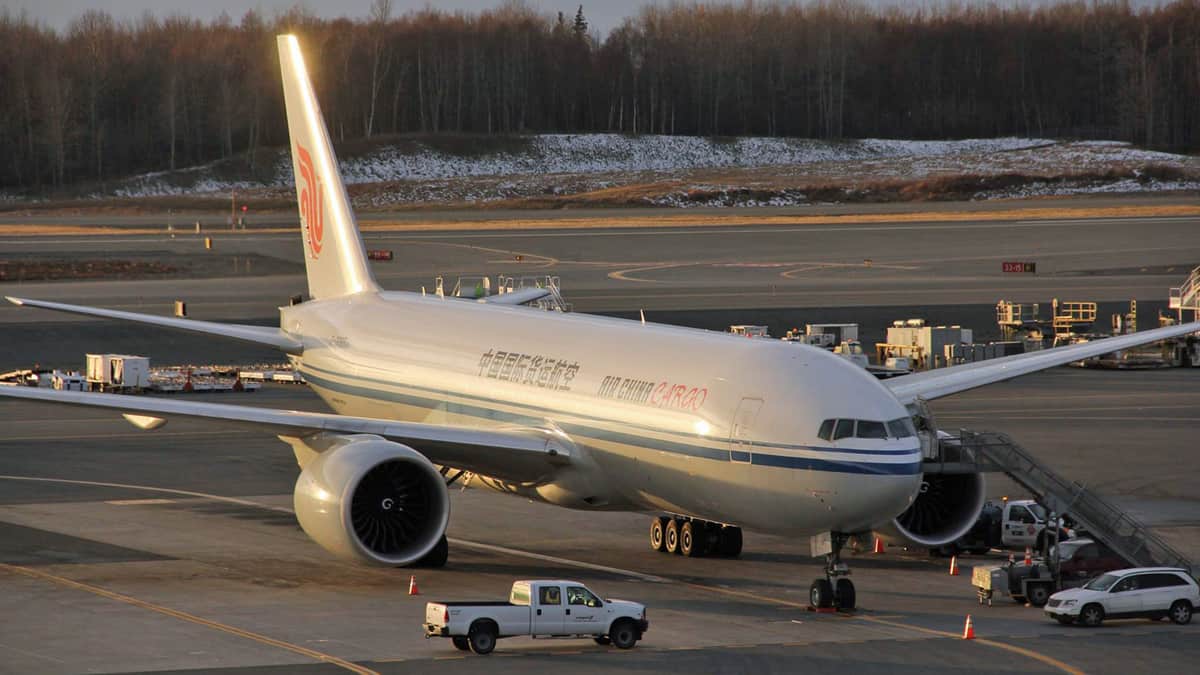
Ted StevensAnchorage International Airport (ANC) is another logistical center of gravity.In this case it is a gateway to the United States for outbound Asia air cargo.About 80% of this traffic lands at the airport for refueling. Why should thatbe when these air cargo planes are quite capable of overflying Anchorage? Itcomes down to what ANC’s management team calls keeping their airport “sticky.”
Anchoragehas both geographic and operational advantages that are unique along the “greatcircle” between Asia and the lower 48 states. Great circles are the shortestdistance between two points on a sphere. Geographically, Anchorage is justabout the distance (i.e., 4,400-4,800 nautical miles) a fully loaded jumbo orwide-body U.S.-bound air cargo plane can go from, say, Hong Kong. So, if theintent is to fill the planes in Asia with more revenue-earning cargo and lesscost-inducing fuel, it makes sense to land and refuel in Anchorage. It alsohelps that ANC works hard to keep its landing fees and fuel charges very low byindustry standards. ANC is centrally located at 9.5 hours flying time to 90% ofthe industrialized world. This makes it an excellent air cargo trans-shippingpoint.
This operational advantage is accentuated by ANC’s innovative air cargo transfer program. Belly-to-belly transfer of U.S.-bound cargo between a foreign air carrier’s planes or between those of two different foreign air carriers is illegal at any other airport in the continental U.S. In fact, ANC’s management team has had to work hard to convince skeptical Asia-based carriers that this quasi-cabotage activity is quite legal.
What makesit hard to believe at first is why the United States would offer such aunilateral trade benefit to countries like China and Japan. Basically, Alaskanscan thank the advocacy of the late Sen. Ted Stevens when he wrote this unique operationinto a re-appropriation bill for the Federal Aviation Administration (FAA) backin the mid-1990s. At ANC, airport managers know that their air carrier customerscan literally fly away, so they must be imaginative to maintain the airport’scenter of gravity against other U.S. and Canadian airports looking to attractAsia-U.S. traffic.
Strategy istypically informed by some vision of the future. The further into the future themore the uncertainty. But uncertainty needs to be confronted and not avoided bysimply limiting mission statements and strategies to five- to 10-yeartimeframes. Sticking with Alaska and thinking ahead over the next few decades,consider the fact that the Arctic is steadily warming and its ice cap ismelting. Therefore, imagine the day when the Northwest Passage between theBeaufort Sea and Baffin Bay becomes navigable to deep draft ocean vessels on ayear-round basis. Centers of gravity for ocean freight may well change. In thisscenario, ports along the Aleutian Islands archipelago (e.g., Adak and DutchHarbor) may become strategically important as bulk and container trans-shippingpoints. Ocean vessels heading along the “great circle” between Asia and U.S.West Coast ports could stop at such a port and switch cargo with vesselstraveling routes between Asia and Europe via the Northwest Passage.
Singapore’simportance in trade began in the early 19th century when the BritishEast India Company established it as a port of call in the spice trade. It hasworked hard to maintain its center of gravity in container trans-shipping. The strategicquestion for the future is “will global climate change give Alaska a new placein the sun?” Who knows – one day a port out in the lonely Aleutians just mightbecome the “Singapore of the North.”


