
Cambodian garment factory workers, Filipino call centre staff and Indonesian office clerks are just some of the workers who could be replaced by robots.
No longer the stuff of science fiction, advances in artificial intelligence are now making it easier for a wide range of jobs to be automated, either entirely or in parts. Big data, machine-learning systems, improved visual sensors and speech recognition, better mobility and dexterity are allowing robots to undertake more complex activities and even work alongside humans. And as industrial robots get cheaper, they are also being adopted in large numbers by historically low-wage export manufacturing countries — particularly China.
The informal sector is likewise poised for transformation, due to widespread penetration of mobile phones, and digital platforms springing up for services including taxis and cleaning from India to Uganda.
The development community has been somewhat slow off the mark to respond to these trends. But 2017 is shaping up to be the year in which that could change, thanks to a growing body of research from the Oxford Martin School, ILO, World Bank and ODI; recent debates organised by Bond and the Institute of Development Studies; and a new ‘do tank’ from the World Economic Forum.
For development professionals interested in this agenda, here’s my take on the key things to know about how the future of work is transforming and the implications for development — plus a few ideas about how we might respond.
1. Automation and digitisation won’t just affect the West — jobs in developing countries are even more at risk.
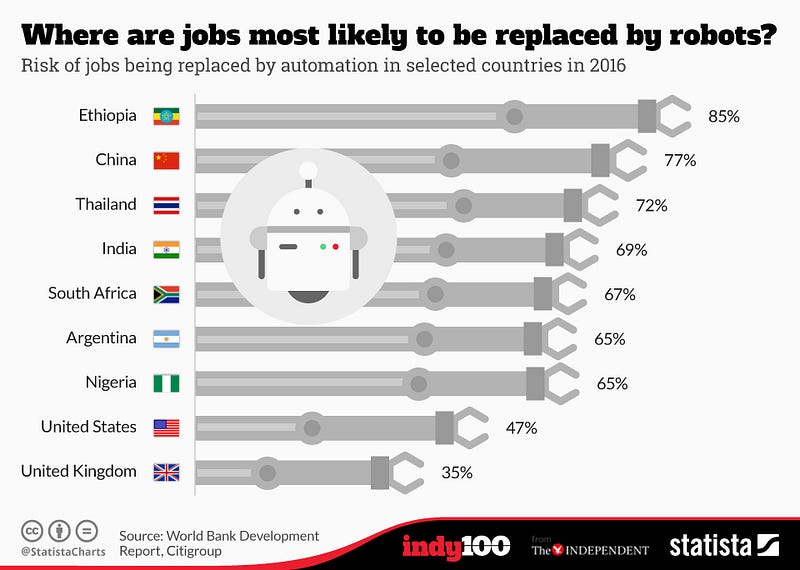
AI lawyers, hedge fund managers and surgical robots have all hit the news in recent months. But it is low-skilled jobs in transportation, manufacturing, logistics, office and administrative support, or service occupations that are considered particularly vulnerable because they can be more easily automated. Because developing countries tend to have more of these low-skilled jobs, they are highly susceptible (rich countries tend to have more jobs that involve creativity and complex social interactions, which are harder for machines to replicate). Up to 85 percent of jobs in Ethiopia are at risk of automation, while 56 per cent of the total workforce in Cambodia, the Philippines and Vietnam, Thailand and Indonesia is at risk of being displaced by robots.
2. Inequality could become further entrenched, with women standing to lose most
The type of jobs that could be displaced — such as sewing machine operators and shop sales assistants — tend to be female-dominated jobs, and those done by less educated workers. If, as predicted, women gain just one job for every five or more jobs lost to technology advances (whereas men stand to gain one job for every three jobs lost), it will certainly deal a blow to recent efforts to promote women’s economic empowerment. With digital skills becoming more critical, it does not bode well that women are up to 50 per cent less likely than men to have access to the internet.
3.Developing countries will need to find new routes to economic prosperity
The declining cost of robots means countries with low-wage labour will lose the competitive advantage that has historically helped them attract businesses and create jobs. Improvements in 3D printing are also expected to lead to the ‘reshoring’ of manufacturing in home markets — raising concerns of ‘premature deindustrialisation’ in emerging economies. If it is no longer possible for developing countries to create prosperity by shifting workers from the farm to factory, then new routes to economic growth will need to be found. The health, ‘green’ and IT sectors are all tipped for expansion (think: data scientists, software programmers and engineers) — jobs that will in all likelihood require people to be highly skilled.
4.Social and economic policies will require a radical rethink
As work becomes more digitised, the ‘gig economy’ is likely to grow. The precarious nature of this freelance, piecemeal work, has led to a resurgence of interest in the idea of a universal basic income provided to all citizens. Helping people retrain and upskill for new jobs will require much stronger workforce planning and coordination between business, government and the education and training sectors. Investing in higher education is an obvious response to a looming skills mismatch, but governments will need to find better ways to tax the digital economy if they want money for such initiatives. The wider context for any new policies also poses challenges; ageing populations globally, plus a ‘youth bulge’ in Africa that will see an additional 400 million people under 25 in need of sustainable employment.
5. The future isn’t set yet — it can still be influenced
The trajectory of these trends depends on our response to them. The transformation of work could lead to greater insecurity and inequality — but it doesn’t have to. Emerging digital cooperative models such as Colony provide a glimpse of an alternative possible future (imagine if Uber were owned by its drivers). Here are some ideas for how development organisations could proactively respond before it’s too late.
- Futures advocacy — influencing the narrative and values that will shape the adoption and use of new technologies, as well as helping realise a positive vision for the future of work.
- Future smart programmes — innovating within our livelihoods and education programmes so that they are fit for purpose as emerging trends bite
- Provide angel investment — support grassroots innovators who are already experimenting with ways to make new technologies work for marginalised workers? Hello Tractor, and these platform cooperatives, are emerging examples.
- Championing a labour movement for the digital age — working to constrain new concentrations of wealth and power, and forging new standards for employment relationships in the gig economy
As Bond continues to explore this issue with our members and partners, please follow this blog for updates, or use the comments to share how your organisation is responding.


