

Who isn’t ready for a happy New Year?
Photographer: Robyn Beck/AFP via Getty Images
Photographer: Robyn Beck/AFP via Getty Images
To get Brooke Sutherland’s newsletter delivered directly to your inbox, sign up here.
Let’s not jinx ourselves, but assuming the calendar doesn’t get thrown off like everything else in 2020, this godawful year will finally end in two weeks. While it will be busy for those involved in the historic Covid-19 vaccine rollout, it feels safe for the rest of us to start thinking about 2021. Here are the big themes that I’m watching:
Recovery Watch: With a vaccine on the horizon, the recent rise in coronavirus cases across the U.S. doesn’t appear to be making much of a dent in the manufacturing rebound. 3M Co. this week said revenue rose 7% on an organic basis in November — in line with October after adjusting for the difference in the number of business days. Most notably, the transportation and electronics segment — which has faced weakness in markets tied to consumer devices and automotive production — had sales growth for the first time since the company began disclosing revenue on a monthly basis in April. Industrial distributor Fastenal Co. said earlier this month that daily sales climbed 6.8% in November, with revenue from manufacturing customers increasing relative to the year-earlier period for the first time since February. That resilience bodes well for what’s set to be a challenging winter of perilous pandemic conditions before an expected strong spring for manufacturing. The fierce rally in industrial stocks over the past month has left analysts split on how much of the good news is already priced in. The manufacturing sector historically tends to underperform after the Institute for Supply Management’s gauges of activity and new orders hit the kind of strong levels seen recently — a buy-the-rumor, sell-the-news phenomenon.
A Recovery is Taking Hold. Now What?
The ISM’s gauge of new factory orders hit the highest level since 2004 in October
Source: Institute for Supply Management
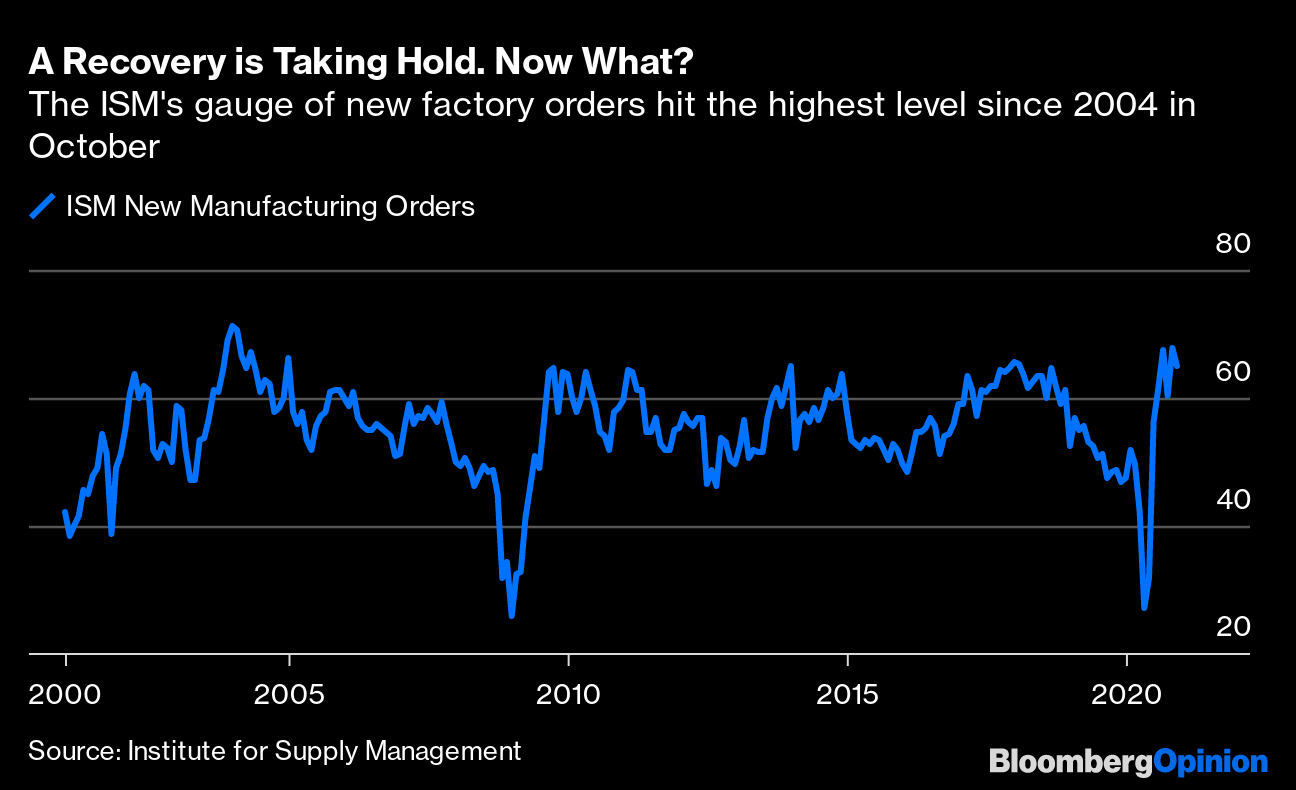
Wolfe Research analyst Nigel Coe thinks the sector may buck the trend this time because the recovery is still in the early stages and valuations (while high) aren’t egregiously out of whack with the broader S&P 500 Index amid a lower-for-longer interest-rate environment. Barclays Plc analyst Julian Mitchell, on the other hand, sees no reason for the historical pattern to change. As terrible as 2020 was, the average revenue drop for industrial companies will only be about half of what the sector saw in 2009, Mitchell estimates. So while there undoubtedly will be a sharp snapback from depressed 2020 numbers, the more muted decline suggests a less dramatic recovery than what the sector experienced after the financial crisis. The manufacturing industry has also changed in the past decade. For one thing, there’s been a series of downturns unique to the sector, most recently in 2015 and 2016 because of the oil-price slump and in 2018 and 2019 because of knock-on effects from the Trump administration’s myriad trade wars. Companies haven’t forgotten that experience, and it’s unlikely they will shell out for the kind of additional factory capacity that would support a more aggressive growth outlook, Mitchell said. After all, when industrial companies do spend these days, it’s usually part of a hard pivot toward software.
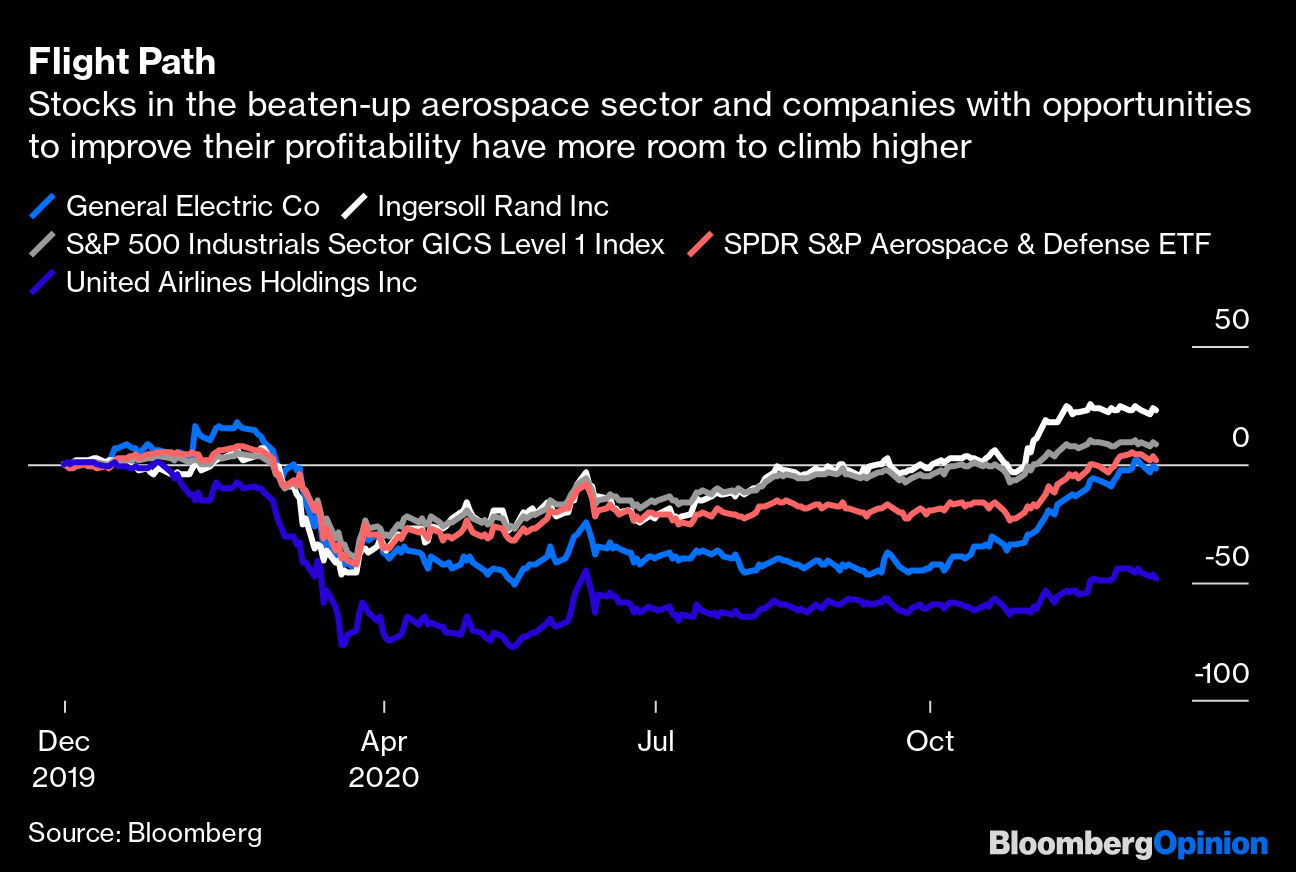
Mitchell recommends focusing on companies that have the potential to improve their business through cost-cutting or asset sales — such as Dover Corp., General Electric Co. and Ingersoll Rand Inc. — or those whose recent growth is part of a larger, lasting trend. The latter group includes air-conditioner companies Carrier Global Corp. and Trane Technologies Plc, which expect demand for better indoor air quality and more environmentally friendly buildings to continue post-pandemic. Gordon Haskett analyst John Inch also recommends looking for opportunities in harder-hit industries, such as oil and gas or commercial aerospace. Despite the recent rally, the S&P 500 Aerospace and Defense index is still down more than 15% year-to-date, while the airline benchmark has declined about 30%; that leaves plenty of room for improvement. Passenger-traffic trends are backsliding at the moment as rising case counts and government travel warnings keep many fliers at home, but carriers are optimistic about a sharp rebound once a coronavirus vaccine becomes more widely available. Case in point: United Airlines Holdings Inc. last week said bookings for next summer were down about 40% from pre-pandemic levels, compared to a 70% slump for December and January.
Flight Path
Stocks in the beaten-up aerospace sector and companies with opportunities to improve their profitability have more room to climb higher
Source: Bloomberg
Spending with Caution
Deal activity at North American industrial companies has slowed to a crawl during the pandemic
Source: Bloomberg
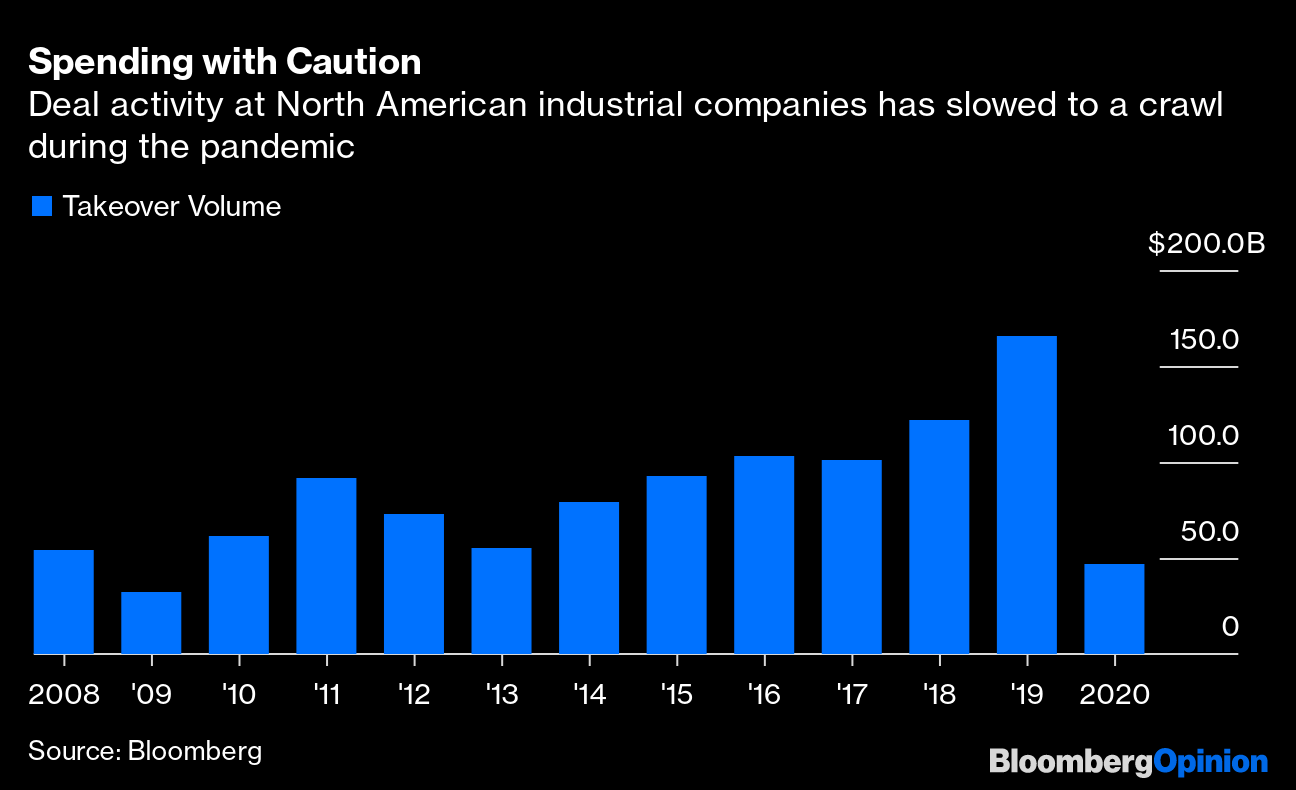
Another area to watch for M&A is in the aerospace market. Airplane-parts manufacturers had already been consolidating pre-pandemic to boost their negotiating clout with companies further up the supply chain. A recovery may force that issue to the forefront once again. Recall that Woodward Inc. and Hexcel Corp. had called off their merger in April; that’s one deal that’s likely to come back in some form. Others may follow the lead of United Technologies Corp.’s tie-up with missile-maker Raytheon Co. and seek to create a more balanced mix of aerospace and defense businesses. The pre-pandemic idea that demand for commercial air travel can only go higher has clearly been turned on its head.
Going Green: During the Trump administration, companies made a point of emphasizing the American jobs they were creating; in the Biden era, we’re likely to hear more about environmental initiatives. U.S. President-elect Joe Biden has pledged to make combating climate change a key issue for his White House and is already moving to infuse environmental policy priorities in virtually every corner of his cabinet, including top roles at the Treasury, Defense and State departments. Companies are adjusting accordingly: General Motors Co. last month pulled support for a Trump administration legal battle over California’s ability to set tougher emissions standards than the federal government. While GM’s involvement in the lawsuit has always been a bit awkward for a company that has tried to position itself as a prime competitor to electric-car maker Tesla Inc., the timing of its about-face suggests that the company knew this legal entanglement put it on the wrong side of a key priority for Biden. Meanwhile, the American Farm Bureau Federation — which previously lobbied fiercely against climate legislation — announced a new coalition to promote policies that reduce agricultural emissions. Even Exxon Mobil Corp., under pressure from two activist investors to dial back its spending and take a harder look at its environmental policies, this week laid out a new plan to curb the amount of pollution per barrel of oil extracted from the ground and begin disclosing additional data on its environmental progress. It’s a half-hearted alignment with a looming peak oil reality that Exxon’s peers have already accepted, but it’s a step forward nonetheless, my colleague Liam Denning writes. Exxon says its emissions targets support the goals of the landmark Paris climate accord. Biden has said he would rejoin the agreement on the first day of his administration.
Robots in America: The pandemic wreaked havoc on supposedly resilient supply chains, particularly in China and Mexico, and sparked speculation that manufacturers would shorten their parts networks and bring more of the production process closer to the point of eventual consumption. If anything, the pandemic accelerated a trend that was already underway after heightened geopolitical tensions made sprawling supply chains untenable. An analysis by Bank of America Corp. found that headcount trends at select U.S.-based S&P 500 capital goods companies hit an inflection point in 2017, when the North American workforce began growing faster than the international one for a change. The types of jobs being created in North America have also changed: between 2010 and 2014, most of the growth in industrial headcount came from corporate roles in finance, marketing and sales, whereas in the past two years, engineering, science and technical jobs grew at the fastest pace. The Bank of America analysts, led by Andrew Obin, interpret this as evidence of a “gradual reshoring” of manufacturing work to North America. The extent to which this translates into U.S. jobs for people (as opposed to Mexican jobs and robots) remains a question mark. The need to reconfigure factories to allow for more social distancing during the pandemic led Emerson to invest in automation, rather than more space: “We’re going to have to bring in automation,” CEO David Farr told the Wall Street Journal. “We’re going to have to take labor out.”
Conglomerates
I hope you all enjoyed the special edition newsletter on latter-day conglomerates this week. It remains easier to break up a conglomerate than to run one, and the lumbering, unconstrained U.S. giants of old are unlikely to make a comeback, no matter what the crisis of the moment happens to be. But the “conglomerates-are-dead” line of thinking has always struck me as ironic because there are still quite a few diversified companies in the industrial ranks — not to mention the technology sector, which has demonstrated a growing inclination toward corporate sprawl. So rather than write the umpteenth story about what’s wrong with industrial conglomerates, I set out to unpack what the success stories — companies like Fortive Corp., Roper Technologies Inc. and Honeywell — get right. Simplicity will still win the day in most cases, but the industry’s dogmatic pursuit of focus has gone too far. Diversity can still be an asset, when used correctly. Here’s the piece if you haven’t yet had a chance to read it.
Holiday Shipping: Discuss
All of this e-commerce ordering means a mountain of cardboard on doorsteps, so much so that there’s actually a shortage of small boxes this year, according to Matt Reddington, director of global design services at Veritiv Corp., a $300 million provider of printing, packaging and logistics services. Veritiv’s customers range from the Fortune 500 to local mom-and-pop shops, and I sat down this week with Reddington to learn more about what the company is seeing and hearing from it customers this holiday season. The small-box shortage is partly a reflection of how we order things; we’ve been trained to order items like tubes of toothpaste or packs of batteries as one-offs. This habit isn’t unique to the pandemic, but direct-to-consumer demand in some cases is now replacing orders for in-store shopping, which would typically come in pallet-sized boxes, Reddington said. This is one reason you get the small-item-in-a-giant-box phenomenon. The surge in packaging demand is colliding with increased concerns over climate change; this has driven greater interest in environmentally friendly materials and ways to shrink the total amount of packaging, Reddington said. It was an interesting conversation, and I encourage you to watch the whole thing here. His advice if you haven’t ordered those holiday gifts yet? Shop local with curbside pickup. On a related note, Amazon.com Inc. is making fewer guarantees on packages arriving in time for Christmas, and FedEx Corp. plans to indefinitely extend certain surcharges. “We believe surcharges will be a part of our pricing strategy moving forward for e-commerce; they are a necessary part,” FedEx’s chief marketing officer, Brie Carere, said on a call this week to discuss the company’s latest quarterly earnings.
Deals, Activists and Corporate Governance
Boeing Co. is scrapping most raises next year and giving out equity grants instead. Executives and union workers (whose pay is set by collective bargaining agreements) are exempt. It’s the latest effort by the company to preserve precious cash during the pandemic. Chief Financial Officer Greg Smith left the door open to raising additional funds through a stock sale earlier this month, but CEO Dave Calhoun said this week the company wasn’t planning on going down that path. Practically speaking, the company has essentially already done an equity raise. In addition to replacing salary increases with equity grants, Boeing has funded both its pension and 401(k) matching obligations with stock this year. On a related note, Southwest Airlines Co. trimmed the number of 737 Max jets it will take through next year to 35, down from an April agreement for no more than 48. And more quality issues have cropped up for the 787 Dreamliner. The problem this time is tiny wrinkles in the carbon-fiber frame that could lead to premature aging. U.S. regulators say this isn’t an immediate safety hazard, but it doesn’t exactly help Boeing’s reputation for quality control.
General Electric Co. agreed to transfer $1.7 billion of pension obligations to Athene Holding Ltd., a retirement-services company backed by Apollo Global Management Inc. The deal affects about 70,000 GE retirees and associated beneficiaries who receive benefits of less than $360 a month; that payout will continue but now be funded through Athene annuity contracts. Considering GE’s $22.9 billion pension funding deficit at the end of 2019, this is the equivalent of carving an ice cube out of an iceberg. But it’s progress nonetheless. GE also said Friday that it’s retiring about $2.2 billion of GE Capital debt, putting the company on track to reduce its overall debt load by nearly $17 billion this year.
Public Storage, a $40 billion real estate investment trust focused on self-storage facilities, is in the crosshairs of activist investor Elliott Management Corp. The hedge fund has taken a “substantial” stake in the company and is seeking six board seats. This is not a typical activist campaign, though. Rather than push for cost cuts or share buybacks, Elliott wants Public Storage to invest more money in its facilities and employees. The investor argues that Public Storage has squandered a first-mover advantage by allowing more aggressive and technologically advanced peers to outflank it. It also wants the company to invest in a proper investor relations team, noting in a letter to the board that management’s prepared remarks during quarterly earnings calls have averaged a mere 22 seconds over the last five years. Public Storage this week appointed three new independent directors of its own choosing but Elliott says this doesn’t go far enough and that changes should be made in consultation with shareholders to bolster credibility.
Dennis Muilenburg has a new job. The former Boeing CEO stepped down around this time last year after a series of missteps in the handling of the 737 Max crisis. Since then, Muilenburg has started a consulting business focused on companies with promising technology. He’s working with electric-tractor startup Monarch as an investor and adviser. He’s also spending a lot of time on a bike; he told Bloomberg News he logged 17,000 miles this year.
Bonus Reading
Time’s Up on Corporate America’s 2020 Climate Goals. Here’s How They Did
Buttigieg May Finally Give Us an Infrastructure Day: Noah Smith
Carrier Goes From Spinoff to Top Industrial Stock in Pandemic
Robots Once Seen as Job Killers Now Protect Workers From Covid
China’s Giant Crop Takeover Has Failed. Admit It: David Fickling
The Problems With Covid Testing for Flights
To Make a Building Healthier, Stop Sanitizing Everything
The U.S. Navy Is Engaged in a Proxy Fight With Pistachio Farmers
This column does not necessarily reflect the opinion of the editorial board or Bloomberg LP and its owners.
To contact the author of this story:
Brooke Sutherland at bsutherland7@bloomberg.net
To contact the editor responsible for this story:
Beth Williams at bewilliams@bloomberg.net


