
Rupa Subramanya is a researcher and commentator. She is a distinguished fellow of the Asia Pacific Foundation of Canada and the co-author of “Indianomix: Making Sense of Modern India.”
In a column “India the sensible substitute for belligerent Beijing” published in The Australian on Aug. 9, former Australian prime minister, Tony Abbott, now his country’s special trade envoy, made a spirited argument that Australia must ramp up economic and trade ties with India as a more reliable, democratic partner than Communist China.
Abbott, who also advises the United Kingdom on trade, has emerged as a strong critic of the West’s reliance on China as a center of global value chains, or GVCs.
Ever since the trade war with China initiated by former U.S. President Donald Trump and the onset of the COVID-19 pandemic, it has been widely argued that Western multinationals ought to reshore away from China to their home countries to ensure the safety and reliability of production.
Further, it is argued that such reliance on GVCs as is necessary for reasons of cost and scale should be diversified away from China toward other Asian partners. In theory, democratic and law-governed India, with a large workforce, should be an ideal partner.
The reality, however, does not match the rhetoric. As Swiss investment bank UBS noted in a report “Reshoring the supply chain: where, what and how much?” in January, it is not entirely clear that Western multinationals are retreating from GVCs centered on China. One reason, according to UBS, could be that despite wages that are almost three times as high as in India, production costs in China are a measly 5% higher than in India, as China’s vastly larger economies of scale allow them to remain competitive.
Abbott and other China hawks in Australia, and elsewhere in the West, also appear to have over-hyped their economies’ vulnerability to China. Dependence on Chinese-centered GVCs does not automatically translate into a vulnerability if it is possible to pivot at a relatively low cost to alternative sources of supply.
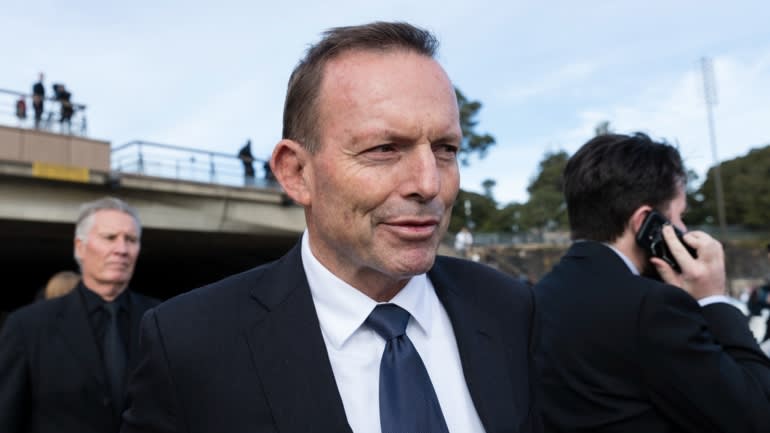 Tony Abbott, pictured in June 2019: the former Australian prime minister has emerged as a strong critic of the West’s reliance on China as a center of global value chains. © Getty Images
According to Australia’s Productivity Commission, the bottom line is that only a small percentage of Australian imports are vulnerable to supply chain disruption. Specifically, only “around 2% of imports are from a single, concentrated source and are used in essential industries,” wrote Commissioner Catherine de Fontenay in an interim report published on Mar. 26, adding that she believes that figure overestimates the percentage of Australia’s economy that may be vulnerable.
Crucially, Commissioner Jonathan Coppel noted that subsidizing domestic manufacturing was not a sensible response, as Australia’s small manufacturing base could not achieve the necessary scale economies. This makes the diversification away from China argument extremely weak.
But, to the extent that nations like Australia wish to diversify away from China for geopolitical or strategic reasons — a factor that Abbott explicitly notes — will India be the country they turn to relocate important chunks of their value chains? The odds of that happening are not good.
Apart from the U.S., which has considerable leeway as the world’s largest economy with a huge domestic market, India is the only major country absent from both of the region’s mega-trade deals: the Western-led Comprehensive and Progressive Trans-Pacific Partnership and the China-led Regional Comprehensive Economic Partnership, which together account for a majority of global trade and economic activity.
Shut out of preferential access to these markets, it is going to be exceedingly difficult for India to break into any of these GVCs that might be relocating away from China. What is more, Indian companies do a poor job of utilizing the preferential access that does exist through India’s patchwork quilt of bilateral free trade agreements.
According to a 2017 report “FTA utilization — An opportunity in waiting for Indian industry” by Deloitte, less than 3% of Indian companies are making use of trade agreements, compared to 80% in advanced countries, mostly because they are not even being aware of the relevant details and so have no knowledge of the preferential advantage available if they did the necessary paperwork. Perhaps this helps explain how poorly integrated India is in existing GVCs compared to other Asian economies which are champing at the bit to get a slice of China’s pie.
A widely used measure of an economy’s integration into GVCs is the World Trade Organization’s “Trade in value-added and global value chains” database. In 2015, the last year for which data is available, the value-added component of gross exports for India was 34.1%, compared to a whopping 55.7% for Vietnam, which leads the way in Asia. All major Asian economies have a higher share than India.
The truth is that India displacing China as a global manufacturing hub is more about wishful thinking born out of geopolitics than it is based on sound economics. India simply lacks the level of integration into existing GVCs to even bring it to the starting blocks. And other developing Asian economies such as Vietnam are far outpacing India in grabbing whatever chunks of GVCs are being relocated away from China.
India may be the world’s largest democracy, but China, supplemented by Southeast Asian economies such as Vietnam, is going to remain the world’s factory for the foreseeable future.


