NEW YORK — The poster boy for the movement that opposes a major increase in the minimum wage is a burger-flipping fraud.

A Japanese “robotic chef” that was held up Thursday as a hassle-free alternative for restaurant owners sick of dealing with human line cooks would simply not be able to do the job, the machine’s manufacturer told The Huffington Post.

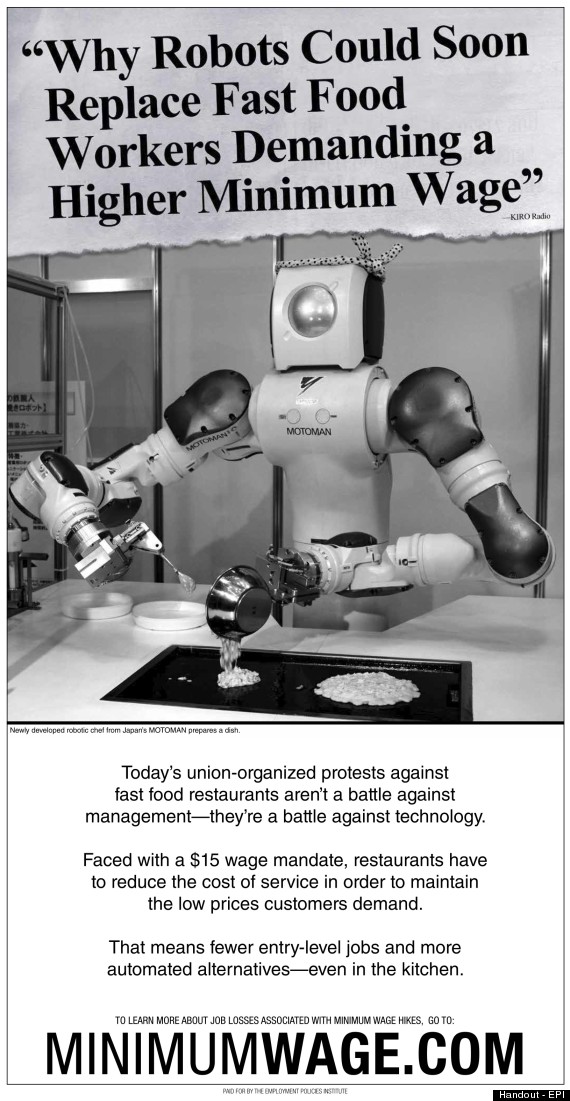
The Motoman SDA10 robot gained brief notoriety Thursday when it appeared on a full-page ad in The Wall Street Journal that stated “robots could soon replace fast food workers demanding a minimum higher wage.” (The ad is reproduced below.)
minimum wage robot

Friday, the Japanese electronics giant that manufactures the robot told HuffPost that the machine was designed for industrial applications and would not be able to replace a cook in a restaurant.

“The robot does not have a real capability for that,” Sam Komiyaji, a marketing manager at Yaskawa Motoman, said in a phone interview from Tokyo.

Komiyaji explained the picture was taken at a 2009 exhibit that was a marketing stunt intended to show the industrial robot has a greater degree of flexibility and dexterity than competitor’s offerings. Similar stunts have seen the same robot deal cards and serve ice cream. During the exhibit, the robot was placed in a carefully constructed kitchen and was able to dump a bowl of pre-mixed batter on a hot griddle, flip a savory okonomiya pancake with a spatula, and serve the meal.

The impressive-looking display only worked, however, because the kitchen was meticulously arranged to accommodate the robot. The machine is designed for repetitive tasks that rarely require discretion, such as packing items into boxes or assembling electronics, and not for more unpredictable tasks, like those involved in cooking.

“When we placed this robot in a kitchen, that’s just in an exhibition kitchen,” Komiyaji said. “We are suggesting this robot for assembling or handling tasks that are very boring. We are looking at it for packing or warehouse work.”

The Yaskawa robot would conceivably have a lot of difficulty as a line cook. Komiyaji said it took engineers two weeks to teach the machine how to go through the motions for the pancake exhibit, and even then it could only do four variations on a dish. A design document from Yaskawa states the robot has only limited ability to deviate from pre-set instructions, which could be a problem if consumers want extra ketchup or no onions on their burgers. The document also states the machine cannot lift more than 45 pounds. A crucial component of the device can’t operate if ambient humidity exceeds 90 percent, an impossible standard for a commercial kitchen. The robot also costs $10,000, is bolted to the floor and requires monitoring by an operator to avoid overheating, Komiyaji said.

In spite of those facts, the research director with the group that used the Motoman in its ad said Friday said he stands by it.

“I completely disagree that the ad is in any way misleading,” said Michael Saltsman, a research director at the Employment Policies Institute. “We’re talking about what’s already possible.”

Saltsman claimed to HuffPost that the robot was “designed” to cook, despite the manufacturers assertion to the contrary.

Saltsman also pointed to another company, Momentum Machines, that he said “has created an automated burger creator that can make 400 burgers an hour without walkouts and without demands for higher pay.”

Momentum, a San Francisco start-up, has designed a conveyor belt-style gadget that assembles ground meat patties, vegetables and buns loaded into specific compartments. The company has developed a prototype and solicited investment.

Repeated requests for comment left with Momentum and company co-founder Steve Frehn Friday morning were not returned.

Saltsman also suggested that retail and food establishments have recently pushed to lower labor costs through the use of machines, be it self-serve soda dispensers at fast-food restaurants or self-checkout touchscreens at convenience stores.

“The technology is out there,” Saltsman said.

Also on HuffPost:

Loading Slideshow...
  • 10. Politics

    Predictions about our robot overlords aside, we will probably never have a robot in the White House. “I think a lot of government jobs may someday be threatened, but probably not those of politicians,” says Ford. A robotic president would require human-like artificial intelligence of a kind that experts may never be able to develop, he points out. And even if they could, the people who kiss babies, give speeches, and make laws for a living will probably retain their gigs.<br><br>

    “The best answer for why we won’t have robotic politicians is that the politicians would never allow it,” says Ford. “Among workers, politicians really have a unique level of power when it comes to protecting their own interests.” However, their support staff–government-paid analysts, auditors, and accountants–won’t necessarily be as safe since much of all of the work they do could be automated some day.

  • 9. Lawyers, Financial Analysts, Creative Knowledge Workers

    Creative knowledge workers–those who have to think creatively for a living–aren’t going to be phased any time soon, either. Take lawyers, for instance. “Much of the core work involves value judgment: what is good, what is bad what is desirable or not,” says Subramani, who points to the opinions judges write as an example. “It’s more than just logical reasoning based on evidence.” Other creative knowledge workers include architects and financial analysts. But those doing non-creative knowledge work, like paralegals who search for and gather data won’t fare so well. “Doing anything that involves consistently executing a rote task–is likely to be where robots are likely to excel,” Subramini adds.

  • 8. Media

    Though content-stripping bots can already cut and assemble simple news stories, and “content farms” are spreading like pop-up stores, writers, editor, and designers are likely to be needed well into the future to help keep the Internet running. “Yes, there are very good ‘off-the-shelf’ programs like WordPress to ‘automate’ how a website gets published,” Kantor notes. “But we need lots of real people to input data, design pages, and write and edit material so that people actually want to read it.” Television channels and magazines will also continue to need to employ people for similar reasons–not just to report on stories, but to design graphics, manage editorial and production teams, and so on.

  • 7. Human Care

    Robots won’t advance that quickly in industries where a human touch is preferable, even if it isn’t entirely necessary, as Subramani points out; in situations where interacting with a machine might be upsetting instead of soothing, humans won’t be pushed out. “For instance, I find it hard to believe that we will have funeral home employees replaced by robots, even though robots may be more efficient,” Subramani says. “I think industries like daycare are reasonably immune for the same reasons.”

  • 6. Most Health Care

    If you’re a doctor, nurse, or physical therapist–working in a healthcare job that requires a lot of direct interaction with patients–there’s probably no need to be looking over your shoulder for a machine version of yourself, says Ford. All the same, he cautions, “there are certainly a lot of areas where automation is developing–like hospital delivery and pharmacy robots. The Japanese are even working on automating some nursing and elder-care functions.” In fact, he adds, systems like IBM’s Watson may even start making diagnoses some day. And radiology jobs–already off-shored to India much of the time, where doctors read scans at much lower cost–are also likely to be largely automated eventually.

  • 5. Environmental Think Tanks

    As the environmental problems brought on by global warming increase–and energy costs rise–more and more people will be needed to study and enact means by which businesses can reduce their carbon footprints. As Kantor points out, we’ll need workers who can measure carbon use, devise strategies to lower it, and guide implementation of those plans. “Lots of people up and down the supply chain will be needed to make such initiatives work–to decide what data to collect and how to collect it, to analyze it, and to figure out which changes to make,” she says.

  • 4. Primary And Secondary Education

    Since there’s no “profit motive that drives efficiency” when it comes to teaching at the primary and secondary levels, these kinds of jobs aren’t likely to be automated any time soon, as Ford notes. But college-level teaching? That might be endangered. “I think higher education will go increasingly online,” says Ford; he notes that six recent experiments found that college students enrolled in courses with machine-guided tutoring software performed just as well as their counterparts in traditional classes. “A few high-profile teachers will lecture huge numbers of students, and there are new software applications that can automate grading,” he says.

  • 3. Managing Automation

    Ironically, even robots needs managers. “Although there’s increasing automation in manufacturing plants in the US, there is a huge–and growing–need for workers who can manage the automation,” says Kantor. “The industry requires people who understand welding, for example, and can also calibrate, maintain, and run the computers that might be doing the welding.”

  • 2. Help Desks

    There is a trend to move help desks–for banks, software companies, and online stores, for instance–back into the U.S., especially in the southeast, where jobs are scarce, according to Kantor. “Increasingly, help desks are ‘on-shoring,'” she says, pointing out that Microsoft now has help centers all over the U.S, in places like North Dakota, Florida, and California. Why the move back? Thanks to the bad economy, hiring U.S. workers is less expensive than it used to be. What’s more, as Kantor notes, language and cultural barriers can make certain customers uncomfortable or impatient; many companies are betting that putting customers more at ease will be good for business. Could a help desk version of Siri be created? Sure, but it’s not likely going to be sophisticated enough to handle all the issues that could come up. When software and hardware need a Sherlock instead of a Siri, a problem-solving human is better than a bot.

  • 1. Wind And Solar Power

    These industries will provide jobs for plumbers, electricians, and construction people, particularly whenever a new power plant or wind farm has to be built. Now sure, parts–like solar panels–are likely to be made by automation. “But they’re hard to install by robot,” says Tana Kantor, Publisher of The Green Economy, a magazine that covers eco-conscious companies and business practices. “Each installation is different, and there is no way to automate or mechanize the process.” She adds, however, that while there will be plenty of work to be done in the development phase, not many people will be needed to maintain plants.