
While people fear automation will cut jobs, Kamler says that overall he’ll have to hire more workers to tend to the robots he plans to buy..
Courtesy: Kent International Inc.
Courtesy: Kent International Inc.
How to bring manufacturing back to America has been a hot-button issue in the presidential election. Arnold Kamler, who has the same goal for his family-owned bicycle business, says both candidates are going about it the wrong way — talking about tariffs or taxes, when they should be smoothing the road for robots.
Kent Bicycles employs about 150 people at a plant in Manning, South Carolina that Kamler opened six years ago. The company still does most of its manufacturing in China and Taiwan, and even this partial reshoring was a risky venture that went against the tide. Kamler would like to take it further, and quadruple his U.S. output to 1 million bikes a year. But he says he’s not getting the kind of government help he needs.
Arnold Kamler
Photographer: Mark Kauzlarich/Bloomberg
President Donald Trump has tried to boost manufacturing by slapping tariffs on imports from China and other countries. In the election, both Trump and his Democratic rival Joe Biden are promising to use the tax system to bring factories home — with a mixture of incentives for companies that do, and penalties on those who produce elsewhere.
“Everyone on both sides likes to make big announcements of taxes and tariffs -– that doesn’t help,” says Kamler. Industrialists in America’s rivals, from China to South Korea and Japan, get substantial help from politicians when they seek to upgrade plants to make better use of robot technology, he says. “The very first thing the U.S. government should do is to help U.S. companies automate.”
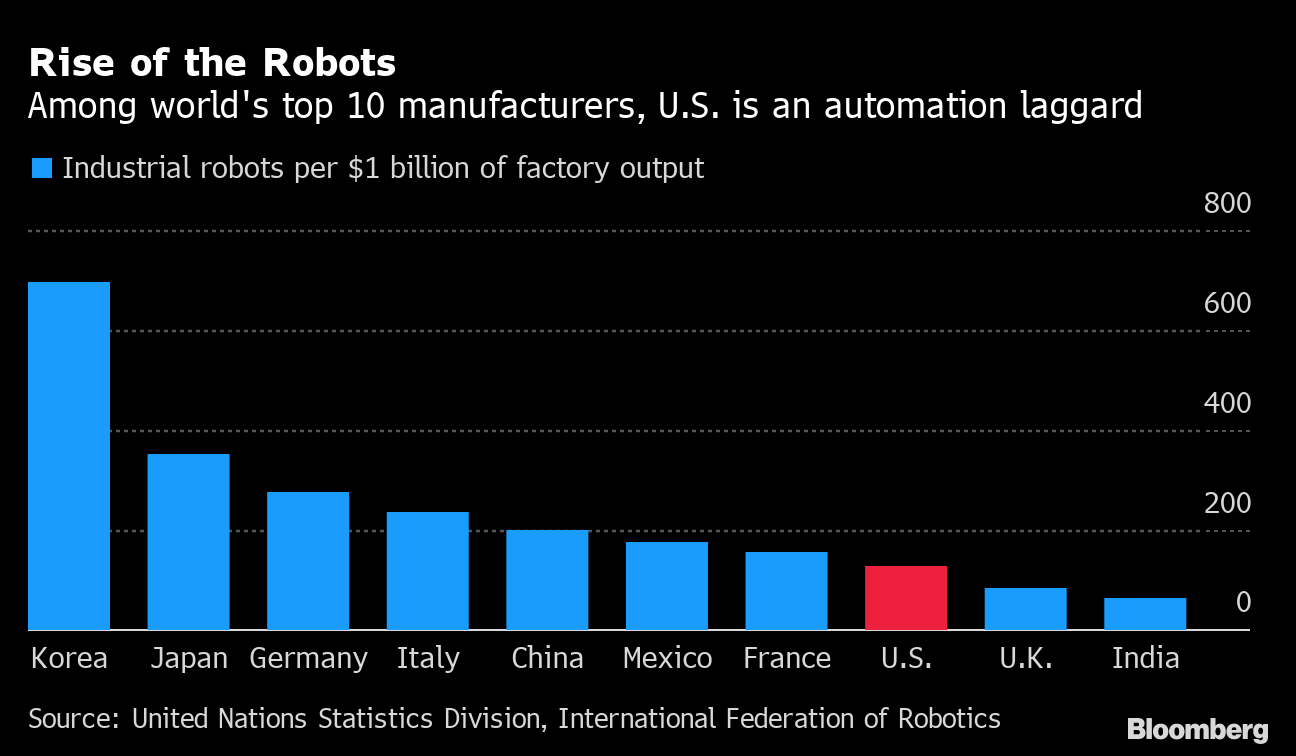
America already has one of the lowest rates of automation among the world’s top industrial powers.
Rise of the Robots
Among world’s top 10 manufacturers, U.S. is an automation laggard
Source: United Nations Statistics Division, International Federation of Robotics
Political arguments circle around the idea that manufacturing, which employed about one-quarter of the U.S. workforce in the 1950s compared with less than 9% now, can once more become a bedrock of middle-class jobs. That’s part of what Trump meant by “make America great again.” It’s been a theme of Biden’s campaign too, with a promise to “create millions of new manufacturing and innovation jobs.”
When the issue is framed that way, automation tends to appear — along with globalization — as an enemy of employment. Walking through Kent’s factory, it’s easy to see why. The plant houses a mix of manual and automated processes, and moving from one to the other feels like time-travel.
Side by Side
In the main area, dozens of men and women assemble the bikes -– each with a specialized job, like looping the chain around the derailleur, or threading brake cables.
A few feet away, in a spotless all-white room, machines spray the frames with matte powder before they’re sent into an oven that bakes the color into a glaze. Only one worker at most is needed — to spray powder manually on any edges that the robots may have missed.
Machines spray bike frames with matte powder. Kent’s factory houses a mix of manual and automated processes.
Courtesy: Kent International Inc.
Kent’s expansion plans would see more of the assembly process carried out that way. Yet Kamler says that overall he’ll have to hire more workers to tend to the robots he plans to buy. There’ll be job openings in other words, and they’ll likely be better recompensed. The paint line requires a higher skill set and pays as much as $1.50 an hour more than the assembly line.
Something like that is true nationwide, according to the Manufacturing Institute, which represents executives in the industry. Its research shows that about three-quarters of manufacturers are planning to boost investments in smart-factory technology over the coming year. A similar proportion said the biggest impact of automation on the workforce will be to create opportunities for people who know how to operate the new machinery.
Carolyn Lee, the institute’s executive director, estimates that there are already about 400,000 openings like that, and says manufacturers will need to fill 4.6 million of them by 2028.
“One of the prime benefits of automation is that it replaces tasks that are repetitive or physically taxing, freeing people to focus on tasks that require human skills and creativity and creating even more jobs along the way,” she says.
Service Jobs
Labor unions, naturally, see this as a rose-tinted view and are more worried about the jobs that will disappear as a result of automation -– about 40 million in the U.S. by 2030, according to a McKinsey’s study.
Shielding employees from that risk is becoming part of the bargaining process. In 2018, a landmark agreement negotiated by Las Vegas culinary workers with local hotels required employers to give six months notice before introducing machines that could displace workers — and to train their staff in how to use them.
The episode shows how automation has spread beyond factories and deep into service industries -– where most job losses during the pandemic shutdown have been concentrated. That could be ominous for the laid-off workers. Brookings Institute researchers have found that automation often takes a leap forward during recessions.
Kent Bicycles has got through the slump without any job cuts — thanks to the surge of interest in cycling among locked-down Americans. It came as a relief to Kamler, after a period when the company got hit by tariffs on almost every part it imports. Kent had to push prices up as much as 20%, and temporarily lay off about 40 staff — one reason Kamler, a Republican, was irritated when his factory briefly appeared in a local Trump campaign video. He says he won’t vote for the president.
“We went months of shipping lots of bicycles and losing money” because of the Trump tariffs, he says. Now, though, “business is off-the-charts crazy good.”
But even with all this new demand, Kamler says robots are the key to ramping up output –- because expanding manual production lines on that scale will push costs too high, and make his bikes uncompetitive. He reckons customers are willing to pay maybe 10% extra for made-in-America products, but that’s the limit.
“If we’re going to make bicycles in a big way, we need a lot more automation,” he says. ‘We just can’t do it the way we used to do it years ago.”


