


 by
by
Two years of shortages – from toilet paper to semiconductors – could finally stem U.S. manufacturers’ addiction to offshoring. Low-wage labor is losing its appeal to businesses as costs related to global transportation and geopolitical disruption continue to rise.
Reshoring to the U.S. increased in 2021, according to the Reshoring Initiative. Job announcements related to reshoring and foreign direct investment (FDI) reached 261,000 last year, bringing the total jobs announced since 2010 to more than 1.3 million. The U.S. computer and electronics industry was one of the main beneficiaries last year with a 17 percent bump in jobs.
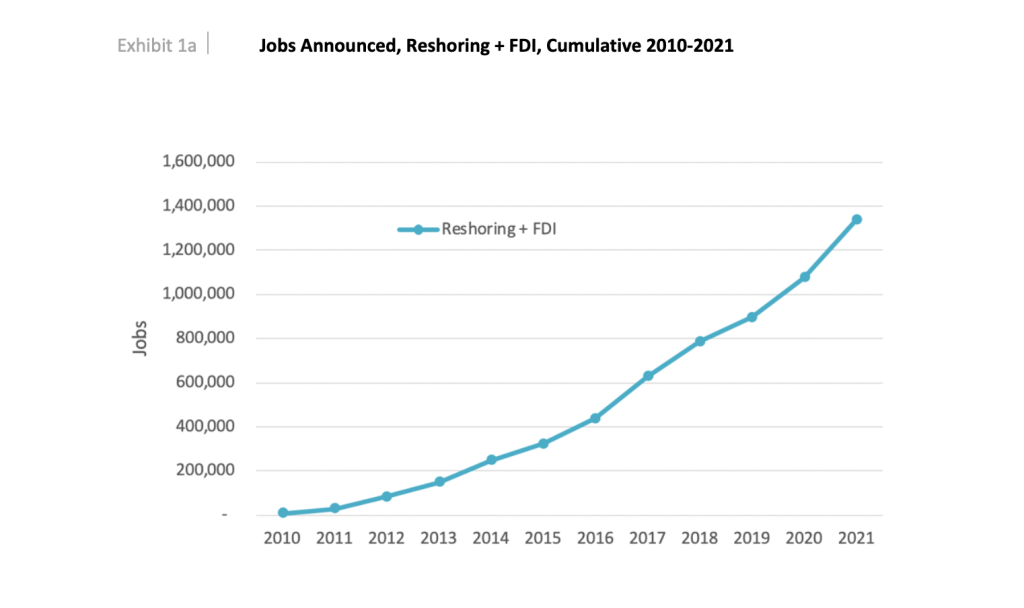
Source: The Reshoring Initiative
Large announcements in 2021 were driven by government support for U.S. production of essential products in short supply due to Covid-19 and dramatic increases in freight cost and delivery time, according to the Initiative. Manufacturers also recognize the total costs of offshoring and rising concern over U.S. dependency on China.
A.T. Kearney, which measures reshoring differently, still sees a reliance in offshore manufacturing but notes there are strong indications that attitudes and strategies are changing. “Thanks to the pandemic, trade wars and tariffs, and ongoing resulting supply chain disruptions, American companies are getting more serious about adopting expanded versions of reshoring.”
Kearney divides the import of manufactured goods from 14 Asian low-cost-countries (LCCs) by U.S. domestic gross output for its reshoring index. Last year, Kearney’s manufacturing import ratio (MRI) found American imports of manufactured goods from the 14 LCCs totaled 14.5 percent of the U.S. GDP, up from 12.95 percent in 2020. That resulted in a negative reshoring index.
The Reshoring Initiative tracks reshoring announcements by U.S. headquartered companies and FDI by foreign companies that have shifted production or sourcing from offshore to the U.S., and through case studies and surveys. It maintains a searchable database of more than 3,700+ articles relating to reshoring.
Nearshoring is a component of reshoring
Kearney has expanded its view of reshoring to incorporate near-shoring as companies pursue the best cost versus the lowest cost. Regionally, the firm added, “companies are also looking at each other to assess if there will be enough critical mass in this redefined reshoring movement to build a supplier ecosystem, either domestically or in a near-shore location, which can rival what China has built.”
More than 90 percent of CEOs surveyed by Kearney view reshoring favorably.
The semiconductor industry, in particular, is being incentivized to reshore. The U.S. and EU have passed spending bills that would build state-of-the-art fabs in those regions. Several chip makers, including Intel, have already announced plans.
The Covid crisis laid bare the U.S.’s over-dependence on imports. In the years since the onset of the pandemic, the global electronics supply chain has been disrupted by factory fires, contaminated materials, cargo ship groundings, increased sea and air shipping costs and geopolitical unrest. The Ukraine/Russian war and tension with China will drive ongoing supply chain shifts, further accelerating reshoring and nearshoring, experts say.
Separately, Covid-related demand for computers and mobile technology spiked in late 2019, consuming the available supply of semiconductors. The automotive industry, which also saw an uptick in orders, was unable to source the chips it needed for car production. That sparked a U.S.-government review of semiconductor manufacturing and more broadly, America’s supply chains.
Enabling technologies
Many industries are not yet set up for regional or local sourcing of materials and components. One technology that addresses that need is additive manufacturing, also known as 3D printing. Devices that can be printed on-premises, on-demand are considered more secure as they minimize the risk of damage or tampering in the supply chain. 3D printing also produces the exact number of parts needed as opposed to ordering in volume, providing significant cost savings.
“With a 3D printer you can take one type of input material and create limited output,” explained Charles Lu, product marketing manager for Markforged, a U.S. supplier of 3D printers and materials. “This addresses labor costs, machine time and the costs of holding inventory,” he said. “Our niche is tooling and fixtures in low volumes that you need right now and strong, accurate and reliable production.” 3D printers digitally store product designs which can be reconfigured on-demand.
Electronic devices can be made by printing on a variety of substrates. Electrically functional electronic or optical inks are deposited on the substrate, creating active or passive devices such as thin film transistors, capacitors, coils and resistors.
Some researchers expect printed electronics to facilitate widespread, very low-cost, low-performance electronics for applications such as flexible displays, smart labels, decorative and animated posters and active clothing that do not require high performance.
“If the past few years have taught us anything, it’s that our traditional supply chain thinking—specifically how and where products are sourced, manufactured, and distributed — fails in the face of severe disruptions,” according to Kearney.
Experts say reshoring/nearshoring is vital to building more resilient supply chains which can recover more quickly from disruption. Manufacturers can incorporate and leverage models where components and materials supplies are nearshored and assembly and test is completed in America. This enables manufacturers to source a portion of their materials and components in nearby locations such as Mexico, Central America, and even Canada, said Kearney, while still being able to say their products are manufactured in the United States.
San Francisco-based Tempo Automation, a specialist in quick-turn PCB design and prototyping, and KMC Systems, a designer and manufacturer of healthcare devices, view proximity to their U.S. customers as a competitive advantage. Design revisions, for example, are completed quickly. Most of KMC’s materials are sourced with 200 miles of its Merrimack, NH, facility and Tempo’s supply chain considers component availability in addition to price and other sourcing metrics.


