
The Boston Consulting Group (BCG), who conducts ongoing research on the impact of advanced-manufacturing technologies, estimates that the portion of tasks performed by robots in manufacturing will increase from 10% to 25% worldwide by 2025. In the US, some herald the growing use of robotics saying that it will reshore manufacturing and increase productivity. However, others fear the job losses that robots may create. While robotics may displace some workers, it creates a need for individuals to work with or maintain these technologies. Demand for robotics skilled workers in manufacturing increased 43% when comparing February 2015 to February 2014.
We monitor robotics hiring trends and discovered that in February, the manufacturing sector accounted for the highest percentage of robotics job ads, 14%. (The healthcare sector had the second most robotics demand.) Engineers, IT, and Installation, Maintenance Repair workers were most commonly required to use robotics skills within the manufacturing sector. Specifically, job openings for the following occupations required candidates to have robotics knowledge.
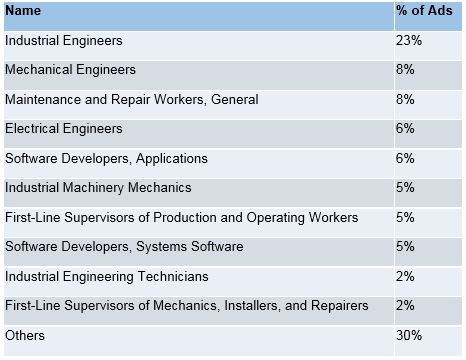
Jobs with the Most Demand for Robotics Skills in the Manufacturing Sector
SOURCE: WANTED Analytics
Of the in-demand manufacturing jobs requiring robotics skills, Industrial Engineers were most needed, representing 23% of ads. Mechanical Engineers and Maintenance Repair Workers also were among the most demanded manufacturing professionals with robotics skills.
Considering the fear that robotics may displace workers, we reviewed manufacturing jobs with declining demand. In February 2015, just 6 of the top 50 most advertised manufacturing jobs had fewer openings posted online than they did at this time last year. Each of the declining jobs were down less than 10%. These jobs included office and administrative and sales functions. Compared to the prior quarter, none of the most in-demand jobs saw decreasing demand.
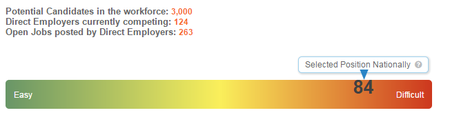
If you’re sourcing candidates with robotics skills, recruiting conditions remain moderately difficult. On average throughout the US, robotics skills score a 58 on the WANTED Analytics Hiring Scale. The Hiring Scale ranges from 1 to 99, with 99 meaning hardest-to-fill. Industrial Engineers with robotics skills in the manufacturing sector score an 84, indicating very challenging recruiting conditions. Even outside of this sector, this combination of knowledge is also difficult-to-recruit, scoring an 83.
BCG suggests that manufacturers should start preparing for the increasing use of robotics by training their workforce for new skills. Examine your workforce planning to see what jobs your organization is likely to be recruiting and upskill existing employees to fill these positions.
Source Article from http://www.nola.com/careeradvice/2015/05/robotics_taking_over_or_compli.html


