
Capex spending should pick up in the industrials and materials sectors as companies move production to the U.S. from Asia because of recent supply-chain disruptions, Ohsung Kwon, an equity and quant strategist with BofA, told MarketWatch by phone Monday. The “reshoring” of manufacturing to the U.S. may become a “big driver” of capex growth, which has been “sluggish” over the past few years, he said.
Automation will probably be part of that trend, as some spending will be aimed at “replacing humans with robots” as companies seek to cope with labor shortages in the pandemic, Kwon explained.
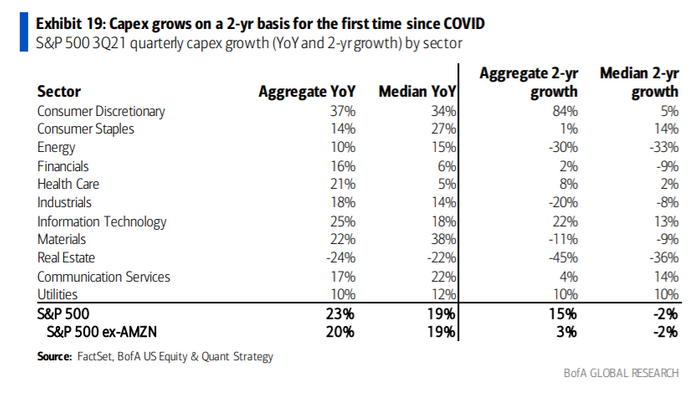
Mentions of supply chains have soared during third-quarter earnings calls amid concerns over bottlenecks and related inflationary pressures, according to the report. Meanwhile, the two-year growth rate for capex has turned positive for the first time since the COVID-19 crisis, the BofA analysts found, as companies seek to adjust to supply challenges.
“With lingering bottlenecks in the economy, we expect companies to increase capex to boost efficiency, particularly on automation,” the BofA analysts said in the note. “The capex pickup is bullish for small-caps, one of our preferred current themes within U.S. equities.”
The Russell 2000 RUT, +1.80%, a U.S. equities index tracking small-cap companies, rose 2.7% on Monday to finish just shy of a record. The gauge has climbed more than 19% this year.
Read:Are supply-chain disruptions ‘transitory’? Odds are low so here’s where to invest, says an analyst
The S&P 500 SPX, +0.65%, meanwhile, edged up 0.2% to log a record finish, resulting in year-to-date gains of 22.8% for the U.S. large-cap index, FactSet data show.
Capex has increased 23% year-over year for S&P 500 companies based on third-quarter results so far, according to BofA. That surpasses the 17% growth seen during the second quarter on a year-over-year basis.
A new capex cycle may be emerging following a surge in corporate spending on software and information-processing equipment that Oxford Economics cited in a report in September. The firm explained at the time that companies were focused on technology-related investments to support remote work during the pandemic.
See:Corporate profit boom is driving spending in this key area, not office buildings
With third-quarter earnings now under way, S&P 500 companies are showing a 15% increase in capex on a two-year growth basis, according to the BofA report. That growth rate drops to 3% when excluding e-commerce giant Amazon.com AMZN, +2.15%, the analysts said.
Labor and supply-chain challenges are costing Amazon billions of dollars in the pandemic, with the company still looking to add workers to meet demand, MarketWatch has reported. Amazon’s stock dropped after a third-quarter earnings miss and fell 1.6% in Monday trading.
See:Amazon hired 628,000 people but is still short staffed
Still, a majority of S&P 500 companies have beat earnings estimates for the third quarter, the BofA report shows. Earnings, led by energy XLE, -0.83% and financials XLF, +0.37%, continue to “surprise to the upside, beating consensus by 7%,” the analysts said.


