
A worldwide problem felt in Central Massachusetts. Some companies are suffering. Others are making do.
WORCESTER — Not enough containers to store homemade ice cream.
A bicycle shop can’t make repairs because parts aren’t coming in.
And this month, Polar Beverages, one of Worcester’s largest companies, cut its manufacturing schedule down to three days during a one-week stretch — from its normal 24/7 production cycle — because it couldn’t get carbon dioxide and nitrogen to run its business.
“It’s a disaster,” said Chris Crowley, executive vice president at Polar Beverages.
Those are just some of the supply-chain disruptions in Worcester caused by the coronavirus pandemic that have some business owners — and customers — wondering how long this is going to last.
President Joe Biden announced this month the port of Los Angeles will remain open around the clock so a massive backlog of products sitting on container ships will get unloaded, put on trucks and shipped out nationwide.
As part of Biden’s plan, major companies like Walmart, FedEx and UPS will boost overnight shipments.
Meanwhile, prices of consumer products have skyrocketed because there aren’t enough items on store shelves to meet rising demand.
Won’t go on forever
“The crisis is not an indefinite one,” Lagnajita Chatterjee, assistant professor of business at Worcester State University, said.
Chatterjee, like all market watchers, doesn’t know how long the supply-chain fiasco will last. She is living the experience of waiting weeks — or months — for orders to arrive.
A desk Chatterjee ordered for her apartment didn’t arrive before her teaching schedule commenced at Worcester State.
She improvised by sitting on her couch, with a stack of books on her lap, and a laptop perched on top of the books.
“I was teaching like that for a week or two,” Chatterjee said.
Complex issue
Supply-chain headaches highlight a global economy that is a complex network of interconnected parts. If one goes down, the whole system falls apart, said Victor Matheson, professor of economics at the College of the Holy Cross.
Put another way — it’s like a new car, assembled with hundreds of components.
“If any one part in the supply chain falls apart, you can’t make the car at all,” Matheson said.
Matheson knows the supply-chain nightmare well. In May, he ordered a bulkhead door to keep water out of his home basement.
It hasn’t arrived.
At Polar Beverages, motors and gearboxes the company needs usually arrive in two days. Now it’s several months.
“It’s highly disruptive and not good for business,” Crowley said.
If the supply chain remains stuck in the mud, Matheson said some businesses will put off making investments in their employees and equipment.
That could mean a small business delays buying new laptops for the sales team. Or a business with a transportation fleet doesn’t invest in replacement trucks.
The problem in these scenarios is that nothing lasts forever.
“Eventually all stuff wears out and you have to bite the bullet,” Matheson said
Good and bad
There is a good and bad side to the supply-chain difficulties, said Eric Busenburg, president of Euro-American Worldwide Logistics, a Worcester-based company that stores raw materials and supplies for manufacturers.
The bad is rising inflation and Busenburg gave an example.
The price of a shipping container that Worldwide Logistics buys for a client for storing materials has skyrocketed — $2,500 before the pandemic to $25,000 today.
That tenfold increase in cost will be passed on to consumers in the form of higher prices. If consumers refuse the sticker shock, some companies could go out of business.
“Reshoring” is the good news, Busenburg said. Companies experiencing manufacturing disruptions due to supply-chain snafus overseas are reshoring, which means they’re setting up manufacturing in the states.
The Reactory, a biomanufacturing site on Shrewsbury Street in Worcester, is a prime example, Busenburg said. Demand for space there is red-hot.
“A lot of life-science manufacturing is coming back here, and starting in Massachusetts. It’s not stopping. It’s the tip of the iceberg,” Busenburg said.
Supply-chain stories
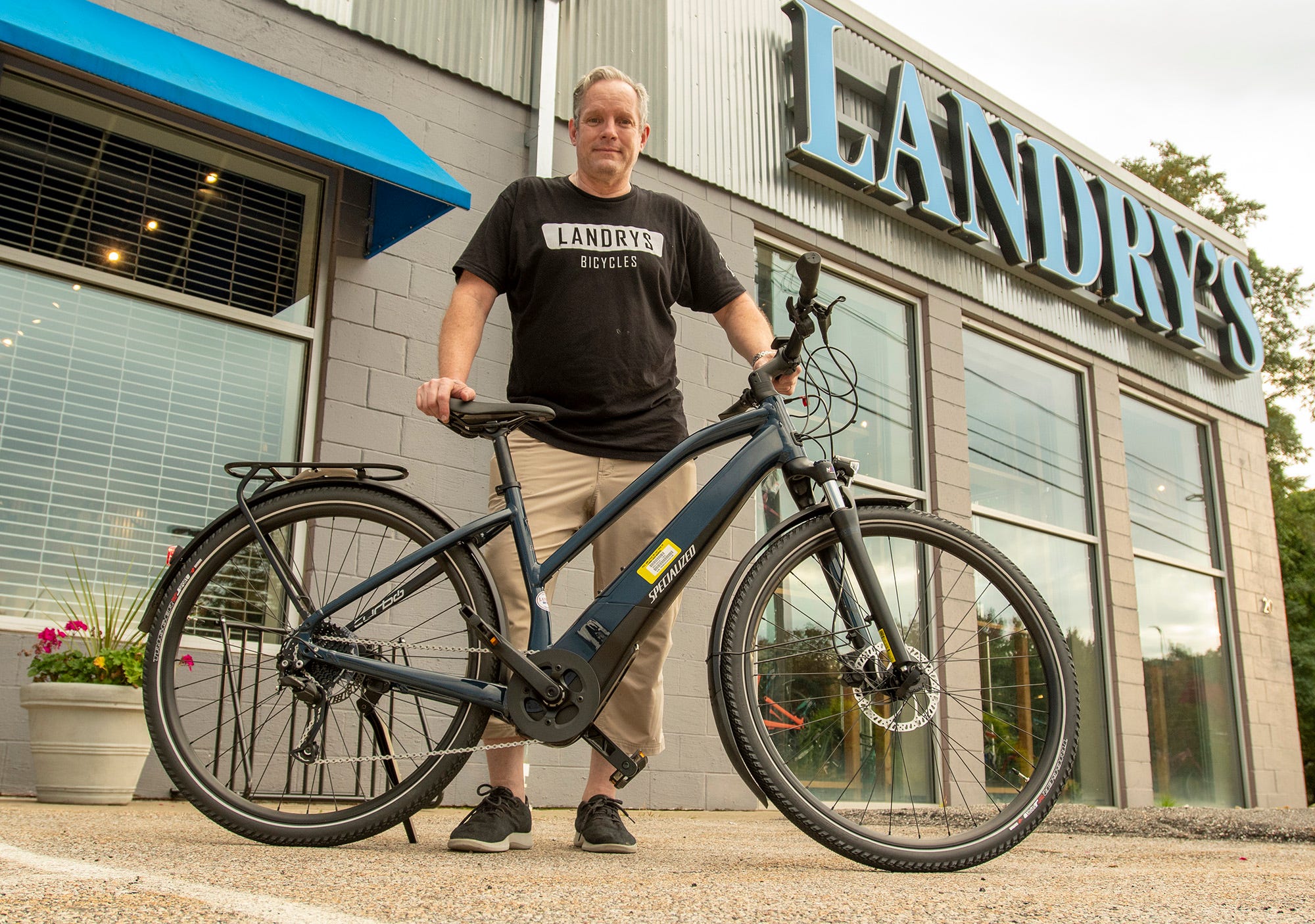
Landry’s Bicycles in Worcester has done a robust business during the pandemic, said store manager Neil Medin. One reason could be social distancing, which made some sports impossible to navigate.
That doesn’t mean Landry’s was immune to supply-chain disruptions. Parts needed for repairs — and new bikes — were hard to come by, so Landry’s took proactive steps to meet the challenge.
The company’s buyers preordered supplies that created a tight inventory system. Stores in Worcester, Westborough and Natick know exactly what is available, and make orders based on purchase commitments from customers.
Landry’s also looked to other suppliers.
“What we’re trying to do during the supply-chain issue is we want to keep cyclists on their bikes,” Medin said.
Supply-chain disruptions haven’t made life any easier for Julia Moriconi.
She owns Mrs. Moriconi’s Ice Cream in Worcester and made her first sale in July 2020, smack dab in the middle of the pandemic.
More: Despite impact of pandemic, Riverdale Mills gets ‘product out the door’
Artisan, hard ice-cream cakes and novelties is how Moriconi described her business. She gets the product out through farmers markets, deliveries and catering.
Last month was a busy selling season and Moriconi couldn’t get certain ice-cream containers. They were either out of stock or there weren’t enough drivers to deliver them.
So Moriconi improvised. She bought a waffle iron and cookie dough, and made ice cream sandwiches that were a hit with customers.
“Labels, containers, spoons, napkins. Everything you need is a problem,” Moriconi said.
Especially containers. There just aren’t enough of them and Moriconi had to pull out of some farmers markets because she didn’t have containers for her products.
Her projected sales for October will take a hit from the supply-chain disruptions — a 66% estimated decline.
“For a small business, that hits especially hard,” Moriconi said.
How to solve supply-chain problem
Getting COVID-19 under control is at the top of the list.
“By far the biggest thing,” Matheson said. That means getting holdouts vaccinated and a vaccination approved for children — plus, the public adhering to mask mandates.
To get low-skill workers back into jobs they left during the pandemic will require businesses to take a hard look at issues like pay, benefits and working conditions.
“We’re seeing real change in the way workers who are low-paid feel about their role in the economy,” Matheson said. “Workers say they don’t want to go back; that life is too short and you better do something to make it higher wages, benefits and working conditions.”
Flexibility is a key, said Chatterjee of Worcester State.
That means companies that normally rely on one supplier of raw materials must look beyond the horizon to find additional sources.
They must also be prepared to quickly pivot into another type of manufacturing when the market goes south. A good example, said Chatterjee, is businesses that started making face masks and hand sanitizer at the beginning of the pandemic.
There is also what Chatterjee called “predictive technology.”
It describes companies analyzing data from crises to predict consumer behavior. From those predictions, products could be developed to stockpile when the next pandemic or worldwide disruption occurs.
Matheson, of Holy Cross, sees that point differently.
From a public health standpoint, it’s possible to plan a stockpile of personal protective equipment, ventilators and oxygen, Matheson said.
But when it comes to predicting what consumers will need beyond public health necessities, that is “probably an impossible job,” Matheson added.
“Who could have guessed there would be huge runs on flour, cookies, yeast, toilet paper. It’s almost impossible to plan all the individual pieces like that in a reasonable way,” Matheson said.
Contact Henry Schwan at henry.schwan@telegram.com. Follow him on Twitter @henrytelegram


