
The Economic Argument for “Re-shoring” Manufacturing Jobs Back to the U.S.
By Dean Franck, Harry C. Moser, Marius Ronge
The White House and Congress seem to announce each week a new plan to “save U.S. manufacturing” While the focus has been on increasing exports, the key to “saving U.S. manufacturing” may be a new dynamic where companies are increasingly purchasing from U.S.-based suppliers, parts previously sourced from overseas. “Re-shoring” is gaining momentum. Caterpillar, for example, recently announced that it will relocate some heavy-equipment overseas production to a new U.S. plant. Re-shoring can’t be explained by companies “just wanting to do the right thing.” Instead, there is a strong business case to be made for re-shoring.
It’s undeniable that developing countries have a labor cost advantage compared to the United States; however, a closer looks suggests that products sourced from these countries may not necessarily provide for the lowest Total Cost of Ownership (TCO) for the buyer. TCO analyzes the entire cost a company incurs when purchasing and using a particular manufactured part. It’s the product price plus any costs which are jointly incurred by the supplier and the buyer, and internal costs incurred by the buyer. The TCO of a manufactured part also includes the non-price TCO components such as freight and packaging, inspection labor caused by the part in the purchaser’s organization and inventory carrying costs, missed customer deliveries due to shipment delays, and travel costs to visit and manage the supplier.
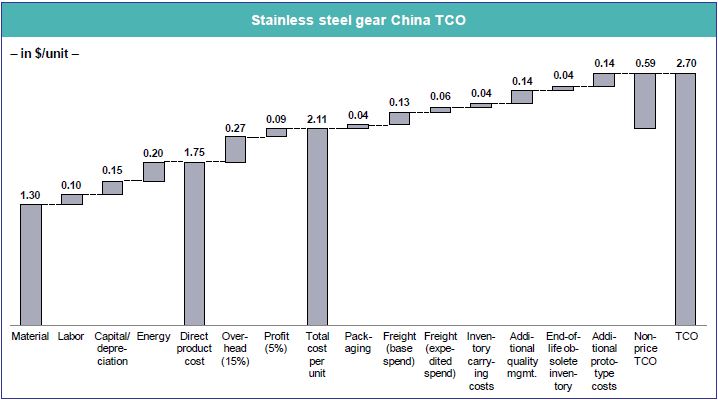
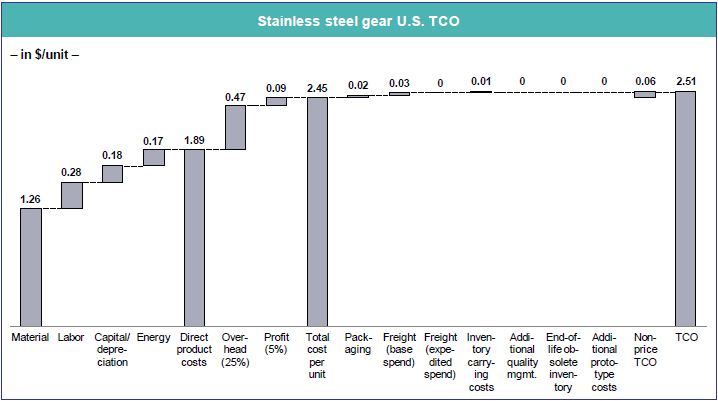
To illustrate, the TCO of a stainless steel gear sourced in China (Exhibit 1) to one sourced in the United States (Exhibit 2) by a U.S.- based customer can be used as an example.
The product price is composed of the following:
- Material costs will be fairly close, with costs in China slightly higher due to a higher scrap rate of 4% vs. 1% in the U.S.
- China’s well-publicized advantage in labor costs is reduced by generally more efficient manufacturing processes in the U.S. but this cannot erase a labor cost differential of approximately 10x (about $2.50 per hour in China compared to $25 in the U.S.).
- In capital / depreciation costs, China again has an advantage of about 20%. China’s often more labor-intensive processes require less machines and therefore less capital to be deployed, but the tougher operating environment means that many machines only last for seven years, compared to approximately 10 years in the U.S.
- A factory in the U.S. will in most cases be able to produce at lower energy costs than its Chinese counterpart. While electricity from the grid is about 30-40% less expensive in China, many Chinese factories must operate on backup generator power for several hours a day or week, due to rolling power outages. This form of electricity generation costs about two or three times as much as power from the grid.
Summing up the above components gives us a direct product cost of $1.89 for the U.S. and $1.75 for China-based production. In addition, a supplier’s overhead and profit must be considered expressed as a percentage of the direct product cost. Assuming a 5% profit for both manufacturers and overhead mark-ups of 15% of product cost for China and 25% for the U.S., the total cost or price per unit is $2.45 in the U.S. and $2.11 in China.
Now add in the non-price TCO components For several of the following components, it’s assumed a minimal or zero base-level cost for the U.S.-produced part and add additional costs incurred in Chinese production to obtain the Chinese TCO.
- At the beginning of a product life cycle, companies will spend significantly more on prototyping for China-sourced products than they would in the U.S. Due to time considerations, this prototype part or tool will always be manufactured in the U.S. A supplier is going to charge more for it because they will not obtain the full life-cycle volume to amortize the prototyping cost against. On a per-unit basis, prototyping costs will be higher, if the full life-cycle run is manufactured in China. In our example, this cost is significant – 5% of the TCO of the unit.
- Packaging for products shipped from China will always be more expensive, but represents a small fraction of the overall TCO. Similarly, freight from China will always be more expensive. In addition, U.S. customers are likely to have to expedite, i.e., air freight, parts from their Chinese supplier from time to time, as supply chain management over such long distances is not going to be perfect. Expediting avoids the risk of a production shutdown, but is expensive, as shown in Exhibit 2.
- Related to the longer supply chain from China are inventory carrying costs. The customer usually pays the Chinese supplier when the goods are loaded onto a ship or truck and a U.S. supplier 60+ days after the goods arrive. Thus the customer must carry that inventory for about 3 months longer if sourced from China. Depending on the value of the parts sourced in China, this number can be relatively immaterial or very significant.
- Additional costs are associated with quality management for parts sourced from China. Quality management costs include the increased manpower for incoming goods inspection, the scrap rates for the parts not making it past the inspection, the rework labor cost associated with fixing substandard purchased parts and the scrap rates and rework of the final product, if problems were missed in incoming inspection and caused a fully assembled product to fail final inspection. In the stainless steel gear example, the additional quality management cost for the Chinese part is significant.
- Looking at the end of the life cycle of a product, with relatively short lead times in the U.S., it is feasible to end a product’s life cycle with zero or very little inventory, whereas companies are finding that they have more parts inventory on hand when they are sourced from overseas, leading to obsolete inventory if the last few weeks of shipped product can no longer be used in production.
Adding up the individual components results in a non-price TCO of $0.59 per unit for the Chinese part and $0.06 for the U.S.-sourced part, for an overall per-unit TCO of $2.70 for China and $2.51 for domestic production.
This example demonstrates that off-shored production may mean “cheaper price”, but not necessarily “lower Total Cost of Ownership”. While the result of the analysis will differ for different parts, it is critical that companies perform a full TCO analysis when considering their sourcing options. This also includes looking beyond quantifiable components to issues such as the security of intellectual property on products and processes; exchange rate fluctuation that may erase overseas benefits; increasing wage rates overseas; distance from R&D research facilities; and regulatory compliance, carbon footprint and enforceable product liability.
The economics of “re-shoring” has created real momentum for companies to take a second look at manufacturing in the U.S. On May 12, 2010, The National Tooling and Machining Association (NTMA) and the Precision Metalforming Association (PMA) will host its annual purchasing fair that will for the first time focus on “re-shoring” in Irvine, CA. More information on the fair can be found at http://tiny.cc/YU9e2
Dean Franck and Marius Ronge are founders and partners of the consulting firm The Gibb River Group, Inc., and specialize in achieving breakthrough cost savings for their clients through highly practical on-the-ground support in Strategic Sourcing, TCO analysis, Lean Manufacturing and Design-to-Cost efforts. Contact mronge@gibbriver.com. Harry Moser is Chairman Emeritus of Agie Charmilles LLC, a leading machine tool supplier.