
The Essential Tariffs Idea
The thought is that we’ve this thing called the GDP equation. All economic activity – GDP – equals government spending plus investment plus consumption plus the effects of trade. Trade effects are that exports minus imports are an addition to the economy. So a trade deficit reduces GDP then.
This doesn’t really quite work in the larger sense because those trade effects are misunderstood. Everything that we’ve consumed is already in the first three terms – therefore the trade effect is simply backing that out to avoid double counting.
But, you know, that’s tending towards politics so not our business here.
But you can see what people then think. If we tax imports so there are fewer of them then we can boost that domestic economy. Which, if we stick with this part of theory, perhaps we can.
Except, of course, if we only impose the tariffs upon one potential source of the imports. Then it’s possible that other foreigners will supply consumers instead. Our net trade position doesn’t change. Or even, can be made worse.
The U.S. Trade Numbers
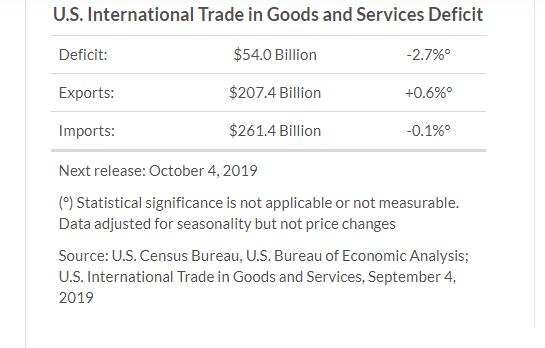
We have the numbers for US trade for the latest reporting month and we’re not really seeing that the tariffs are having a positive effect:
July exports were $207.4 billion, $1.2 billion more than June exports. July imports were $261.4 billion, $0.4 billion less than June imports.
The July decrease in the goods and services deficit reflected a decrease in the goods deficit of $1.6 billion to $73.7 billion and a decrease in the services surplus of $0.1 billion to $19.7 billion.
Year-to-date, the goods and services deficit increased $28.2 billion, or 8.2 percent, from the same period in 2018. Exports decreased $3.4 billion or 0.2 percent. Imports increased $24.9 billion or 1.4 percent.
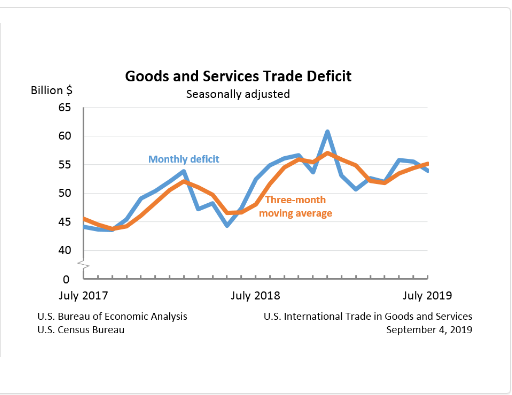
Those very latest numbers seem to imply movement in the right direction. But it’s trivial movement there. Over the past year, by the theory we’re using here, the numbers are going the wrong way.
 (US Trade Figures – Bureau of Economic Analysis)
Or if you prefer a chart:
 (US Trade Figures – Bureau Of Economic Analysis)
The Problem With Trade Tariffs
OK, we we want to reduce the trade deficit. We don’t seem to be having much luck with that.
Part of our problem is that trade policy seems a little uncertain. We’re not quite sure what is going to happen next. That will limit what we’re trying to increase, domestic investment so as to build import replacing production. This is always going to be a problem in the short term with any change in policy.
However, we’ve another problem. Which is that tariffs are only really being imposed upon the one potential supplier China. The problem here is that this could even increase the trade deficit. As Moody’s Analytics points out:
The Trump administration is clearly bothered by the U.S. trade deficit with China. However, the use of tariffs on imported Chinese goods has only shifted the mix of imports away from China to other parts of the world. In July, the trade deficit with China had narrowed by $4 billion on a year-ago basis, but the deficit with the rest of the world has widened by more than $10 billion. Therefore, the tariffs are not reducing the trade deficit in the U.S.
The increase can come from, well, think for a moment. It costs $100 to make in the US. $80 to make in China. $90 to make in Vietnam – these are not real numbers, just for illustration. So, tariffs on China means we move to Vietnam for our supplies, not the US. Our trade deficit has just risen, we’re now paying $90, not $80, and still not producing at home
This can happen. And in some cases it is happening. And what isn’t happening is that production is reshoring back to the US, instead it’s just moving to other non-tariff affected foreign countries.
The Domestic Effect Of Tariffs
As Moody’s also notes:
Elsewhere, the trade tensions are taking a noticeable toll on manufacturing, which is likely in recession. Manufacturing industrial production has dropped in each of the past two quarters and the ISM manufacturing index is now below its neutral threshold of 50.There is little evidence that there has been a significant reshoring of factory production.
The Effects Of Trade Tariffs
We’ve no evidence that the effects of the trade war are being beneficial for the US domestic economy. We have mild evidence that the uncertainty over trade policy is harming US manufacturing.
My View
I’ve long been of the view that there’s nothing particularly wrong with the US domestic economy. The only thing I’ve worried about has been the international scene. Europe falling into a deep recession, for example, wouldn’t help. But the one part of the policy under control of the US itself is that trade policy. And here I’m not really all that worried about what that policy is – only that it be stable.
The Investor View
It’s possible to tell all sorts of bloodcurdling tales about how terrible the effects of a trade war are going to be. But the thing is trade is a pretty small part of the US economy. All the domestic indicators are doing fine. Barring something really strange and odd trade policy is only going to influence at the margin.
If we get an announcement of something like 50% tariffs on all imports then of course all bets are off. But other than that the effects are going to be marginal. And it’s the uncertainty that will be the most damaging, not the policy itself.
While trade is taking up the headlines it’s just not that important a matter for the economy as a whole.
Disclosure:I/we have no positions in any stocks mentioned, and no plans to initiate any positions within the next 72 hours.I wrote this article myself, and it expresses my own opinions. I am not receiving compensation for it (other than from Seeking Alpha). I have no business relationship with any company whose stock is mentioned in this article.


