

It may take awhile to bring these jobs back to the U.S.
Photographer: -/AFP via Getty Images
Photographer: -/AFP via Getty Images
One of President Joe Biden’s stated economic goals is to shift manufacturing supply chains to the U.S., especially from China. This is something that advocates of a rebirth of industrial policy have wanted for a long time. But it’s going to be very hard; the U.S. is swimming against vast tidal forces that are pushing economic activity to Asia. The problem calls for bold and creative thinking.
Usually, when people think of international competition for investment, they think of two countries competing to see which can offer multinational corporations a better business environment. This mental image is extremely incomplete.
First of all, geography matters — when a company invests in China, they get proximity to specialized component makers in Japan, South Korea and Taiwan, cheap assembly in Vietnam and Indonesia, and they’re also closer to all of those end markets. The U.S., in contrast, is geographically isolated, with only Mexico, Canada, and a few small countries nearby.
Second of all, market size matters; the U.S. is still the world’s biggest single consumer market, but China is catching up, and the tantalizing lure of 1.4 billion consumers is never far from corporate manager’s minds. In other words, the U.S. will be fighting against titanic forces of economic geography and population size.
Supply chains also have a logic all their own. Once a network of suppliers and purchasers establishes itself in an area, it can be very difficult to get pieces of that network to move away. Think of car manufacturers and auto parts suppliers in the Detroit area — neither one can relocate without leaving the other behind. China has become that, but on a far more massive scale. For many companies, there’s simply nowhere else they can go that gives them the same confidence that anything they need can be made in the near vicinity.
These factors explain why investment keeps pouring into China, despite the pandemic, the trade war, skyrocketing local wages, and the ever-present threats of technology theft and government-supported domestic competitors. Companies just can’t afford to miss out on East Asian markets or East Asian supply chains.
Fear of Missing Out
Investment continued to pour into China in 2020, despite the pandemic
Source: China’s Ministry of Commerce
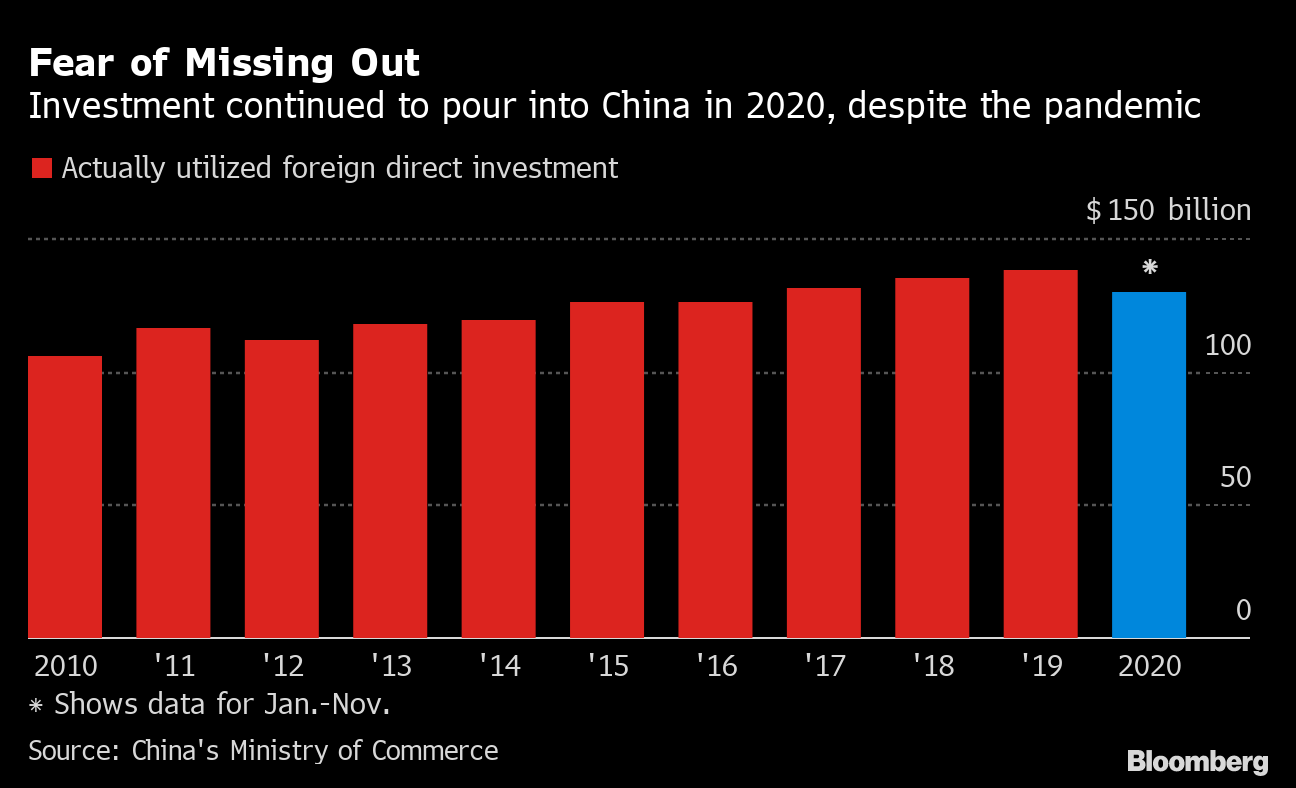
Of course, China isn’t resting on its laurels either — the country has rolled out a big effort to improve the climate for multinational companies, and it’s climbing in the “ease of doing business” rankings. So all considered, it’s no wonder that most of the multinationals that are invested in China are ignoring calls to move business out. Even other East Asian countries such as Japan and Taiwan — known for their skill at industrial policy — are seeing only very modest success getting their companies to diversify out of China.
But this doesn’t mean the U.S. should give up the fight — only that it will be slow going.
The first thing Biden and the U.S. should try is to let states and cities do more. During China’s phase of rapid growth, its central government delegated lots of policymaking authority to local leaders, rewarding them for hitting growth targets and designating Special Economic Zones that enjoyed favorable regulatory and tax conditions.
U.S. policy would necessarily be different, since leaders are elected instead of appointed and giving some locales favorable treatment as SEZs could be politically dicey. Instead, the federal government could make a pot of money available to states and cities for use in implementing local industrial policies. Places that were successful in reshoring supply chains from China would get more money in the future. And the results of the various policy experiments could be scrutinized for lessons that could be replicated nationwide. Basically, this would apply the funding model of scientific grants to industrial policy. Local governments could use the money to build infrastructure, create specialized education to meet companies’ specific needs, provide relocation incentives, bolster universities or anything else they thought of.
This strategy would also free the U.S. from the need to “pick winners” — as in, deciding which industries and which supply chains to target. Such efforts often fail, and are subject to intense politicking; the obvious solution is to diversify.
For a few industries, however, the federal government will have to intervene directly for reasons of national security. Vaccines and other pandemic-related products are an obvious example. Another is semiconductors, which are generally regarded as being crucial for the defense industry. Efforts to talk companies like Samsung and TSMC into putting plants in the U.S. may see some success.
Beyond that, the U.S. really just needs to build up its resources. With fertility rates low and falling, restarting large-scale immigration will be necessary to maintain and increase the country’s market size — a crucial factor for companies deciding where to locate. The scarcity of housing, which is making it too expensive to do business in America’s technology hubs, must also be addressed. And infrastructure and education are perennial priorities.
So it will be a long, hard slog to reshore supply chains from China. But it’s a battle that needs fighting; the only other option is to sit back and surrender the mantle of “economic center of the world” to an authoritarian rival.
This column does not necessarily reflect the opinion of the editorial board or Bloomberg LP and its owners.
To contact the author of this story:
Noah Smith at nsmith150@bloomberg.net
To contact the editor responsible for this story:
Susan Warren at susanwarren@bloomberg.net


